


Addressing Critical Needs in Marine Chemical Sensing
Beyond our traditional “lab on chip” platform we are exploring the use of other sensing modalities to address critical needs in marine chemical sensing. In particular, we are developing fast, miniaturised sensors that use low-power electrochemical techniques to observe water chemistry.
We also develop autonomous samplers which can collect and preserve samples for later chemical analysis, to help ground truth the data from autonomous instruments, and to allow scientists to analyse the samples later for materials which can’t yet be measured autonomously in the ocean.
Miniaturised Multi-Parameter Electrochemical Sensor
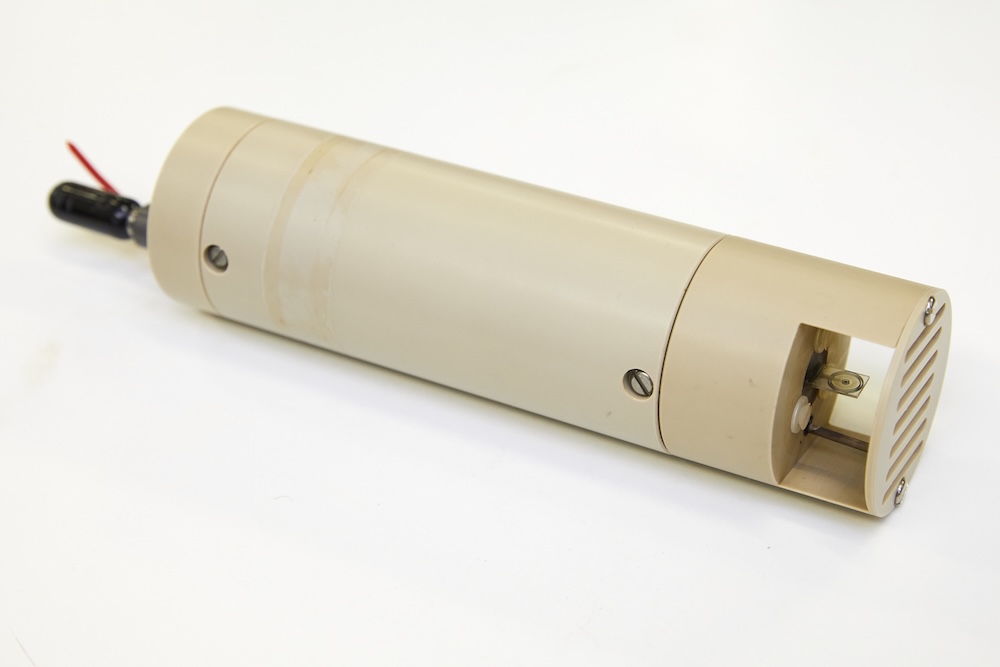
A project, in partnership with the University of Southampton, aims to provide a small and low powered sensor that incorporates a fingernail-sized micro-fabricated chip, which can measure temperature and conductivity, and support dissolved oxygen and Eh (redox potential) measurements. This sensor chip has been integrated into a pressure tolerant package for evaluation and includes the electronics required to operate the sensor and commercially sourced pressure transducer.
Temperature and conductivity measurements are ubiquitous throughout ocean research. These measurements are fundamental in understanding the physical structure of the ocean but also provide valuable contextual information for other co-located biogeochemical measurements. Dissolved oxygen is a critical parameter in understanding the health of the marine environment and its measurement makes it possible to understand where life is under stress or thrives. Eh (redox potential) measures the oxidising or reducing potential of seawater and is a valuable tool for characterisation of environments with complex redox characteristics (such as pore water) and for locating or quantifying sources of unusual chemistry (e.g. hydrothermal vents or seafloor disturbances).
Deployments of an early version containing only temperature and conductivity sensors were carried out in the Atlantic using CTD (conductivity, temperature, depth instrument) casts to a maximum depth of 4.8 km. After pressure correction, the results for both temperature and conductivity compared well with the industry standard technologies.
This miniature prototype has been expanded to include a co-located dissolved oxygen sensor and Eh sensor. So far, these sensors have been trialled at sea and have provided full ocean depth profiles.
Current Specifications
The sensor is under continual development but has been demonstrated to perform to the below specifications in the laboratory.
Temperature acc.: 0.003 °C
Temperature res.: 0.0005 °C
Conductivity acc.: 0.01 mS/cm
Conductivity res.: 0.003 mS/cm
Oxygen acc.: 10%
Oxygen res.: 1%
Eh.: 0 - 2.3 V
Gas Tight Water Samplers
The gas-tight sampler was designed specifically to collect and preserve samples from moorings during long deployments for later laboratory analysis of carbonate system parameters. Currently collecting and preserving samples (maintaining gas content and speciation) autonomously is not technically possible and therefore carbonate sensor measurements on moorings over long unattended deployments cannot be validated and are often deemed unreliable. The gas-tight sampler can collect up to 500 mL of water within a titanium cylinder using an integrated piston. Upon collection, it releases a small volume of mercuric chloride to the sample as recommended in standard operating procedures for carbonate sample collection and storage. The sampler then holds the sample until its recovered. Sample can be decanted in smaller aliquots by moving the integrated piston maintaining preservation in the remaining sample. Each 500 mL sampler bottle is autonomous and can be programmed to collect sample on a pre-determined date and time. Sets of several of these bottles can be integrated on platforms and can be controlled by an external hub. The current version notifies the remote user when each sample has been collected and to what extent collection was successful. Remote operation over telemetry is also possible depending on platform capability.