

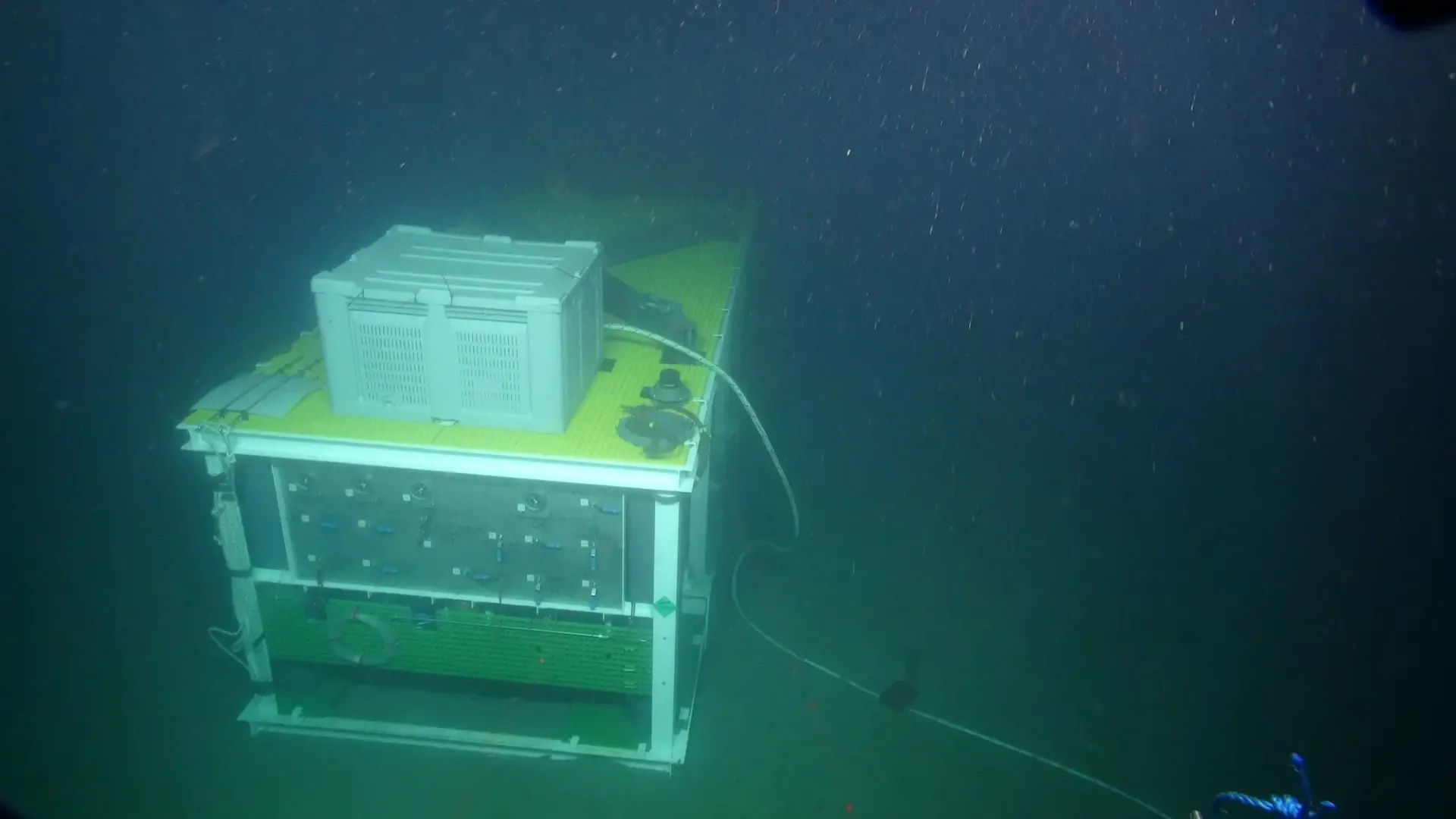
Technology to Study the Seafloor
With over 45 years of experience and over 250 deployments, NOC's experts have a wealth of experience when developing, deploying and operating landers that help to sample, observe and measure the deep ocean.
NOC operates a range of different landers that all have different purposes and produce differing levels of data and results.
CO₂ Release Rig
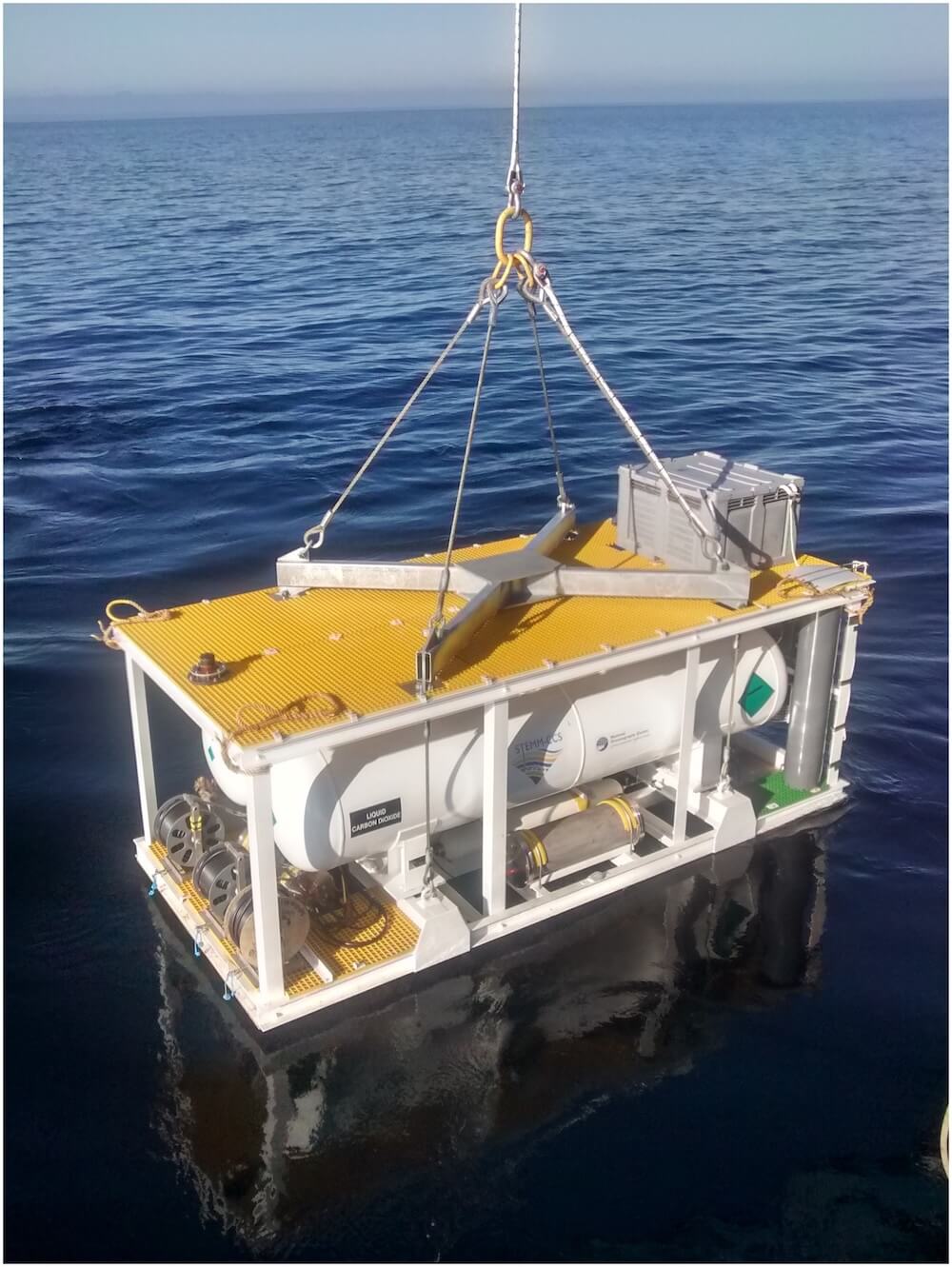
Carbon capture and storage (CCS) is a key potential technology for reducing the emissions of CO₂ to the atmosphere. CCS involves capturing CO₂ at the point of production and storing it in concentrated form, often in geological storage formations such as depleted oil and gas wells beneath the sea. However, implementation of this approach will require monitoring technology to provide confidence in the integrity of the storage site. NOC have been developing such monitoring technologies, but one critical step in proving this technology is testing it successfully underwater.
To undertake controlled tests and demonstrations of CO₂ monitoring technology, we created a system which is capable of providing a highly-controlled, small release of CO₂ under the seabed.
The system has two parts: a tank and control system, which sit on the seafloor, and a sub-seabed pipe which connects to the control system and emits the CO₂ approximately 3 m below the sediment surface. The system can also carry a tracer gas which can be mixed into the CO₂ before release. A flow rate of between 0 and 285 kg/d can be achieved, and the amount can be adjusted while the equipment is at the seafloor.
Specifications
Flow rates: between 0 and 285 kg/d
Volume of tank: 5.6 m3 (~3 t of liquid CO₂ at 20°C)
Ratio of tracer gas to CO₂: 1:10,000
More Information
Flohr, Anita  ORCID: https://orcid.org/0000-0002-5018-5379; Schaap, Allison ORCID: https://orcid.org/0000-0001-5391-0516; Achterberg, Erik P.; Alendal, Guttorm; Arundell, Martin; Berndt, Christian; Blackford, Jerry; Böttner, Christoph; Borisov, Sergey M.; Brown, Robin; Bull, Jonathan M.; Carter, Liam; Chen, Baixin; Dale, Andrew W.; de Beer, Dirk; Dean, Marcella; Deusner, Christian; Dewar, Marius; Durden, Jennifer ORCID: https://orcid.org/0000-0002-6529-9109; Elsen, Saskia; Esposito, Mario; Faggetter, Michael; Fischer, Jan P.; Gana, Amine; Gros, Jonas; Haeckel, Matthias; Hanz, Rudolf ORCID: https://orcid.org/0000-0003-2123-1599; Holtappels, Moritz; Hosking, Brett; Huvenne, Veerle ORCID: https://orcid.org/0000-0001-7135-6360; James, Rachael; Koopmans, Dirk; Kossel, Elke; Leighton, Timothy G.; Li, Jianghui; Lichtschlag, Anna ORCID: https://orcid.org/0000-0001-8281-2165; Linke, Peter; Loucaides, Socratis; Martínez-Cabanas, María; Matter, Juerg M.; Mesher, Thomas; Monk, Samuel; Mowlem, Matthew; Oleynik, Anna; Papadimitriou, Efstathios; Paxton, David; Pearce, Christopher ORCID: https://orcid.org/0000-0002-4382-2341; Peel, Kate; Roche, Ben; Ruhl, Henry; Saleem, Umer; Sands, Carla; Saw, Kevin; Schmidt, Mark; Sommer, Stefan; Strong, James ORCID: https://orcid.org/0000-0001-8603-097X; Triest, Jack; Ungerböck, Birgit; Walk, John; White, Paul; Widdicombe, Steve; Wilson, Robert Euan ORCID: https://orcid.org/0000-0002-2371-9080; Wright, Hannah; Wyatt, James; Connelly, Douglas.
2021
Towards improved monitoring of offshore carbon storage: A real-world field experiment detecting a controlled sub-seafloor CO2 release.
International Journal of Greenhouse Gas Control, 106, 103237.
10.1016/j.ijggc.2020.103237
ORCID: https://orcid.org/0000-0002-5018-5379; Schaap, Allison ORCID: https://orcid.org/0000-0001-5391-0516; Achterberg, Erik P.; Alendal, Guttorm; Arundell, Martin; Berndt, Christian; Blackford, Jerry; Böttner, Christoph; Borisov, Sergey M.; Brown, Robin; Bull, Jonathan M.; Carter, Liam; Chen, Baixin; Dale, Andrew W.; de Beer, Dirk; Dean, Marcella; Deusner, Christian; Dewar, Marius; Durden, Jennifer ORCID: https://orcid.org/0000-0002-6529-9109; Elsen, Saskia; Esposito, Mario; Faggetter, Michael; Fischer, Jan P.; Gana, Amine; Gros, Jonas; Haeckel, Matthias; Hanz, Rudolf ORCID: https://orcid.org/0000-0003-2123-1599; Holtappels, Moritz; Hosking, Brett; Huvenne, Veerle ORCID: https://orcid.org/0000-0001-7135-6360; James, Rachael; Koopmans, Dirk; Kossel, Elke; Leighton, Timothy G.; Li, Jianghui; Lichtschlag, Anna ORCID: https://orcid.org/0000-0001-8281-2165; Linke, Peter; Loucaides, Socratis; Martínez-Cabanas, María; Matter, Juerg M.; Mesher, Thomas; Monk, Samuel; Mowlem, Matthew; Oleynik, Anna; Papadimitriou, Efstathios; Paxton, David; Pearce, Christopher ORCID: https://orcid.org/0000-0002-4382-2341; Peel, Kate; Roche, Ben; Ruhl, Henry; Saleem, Umer; Sands, Carla; Saw, Kevin; Schmidt, Mark; Sommer, Stefan; Strong, James ORCID: https://orcid.org/0000-0001-8603-097X; Triest, Jack; Ungerböck, Birgit; Walk, John; White, Paul; Widdicombe, Steve; Wilson, Robert Euan ORCID: https://orcid.org/0000-0002-2371-9080; Wright, Hannah; Wyatt, James; Connelly, Douglas.
2021
Towards improved monitoring of offshore carbon storage: A real-world field experiment detecting a controlled sub-seafloor CO2 release.
International Journal of Greenhouse Gas Control, 106, 103237.
10.1016/j.ijggc.2020.103237
2021
Article
Benthic Biogeochemistry Landers
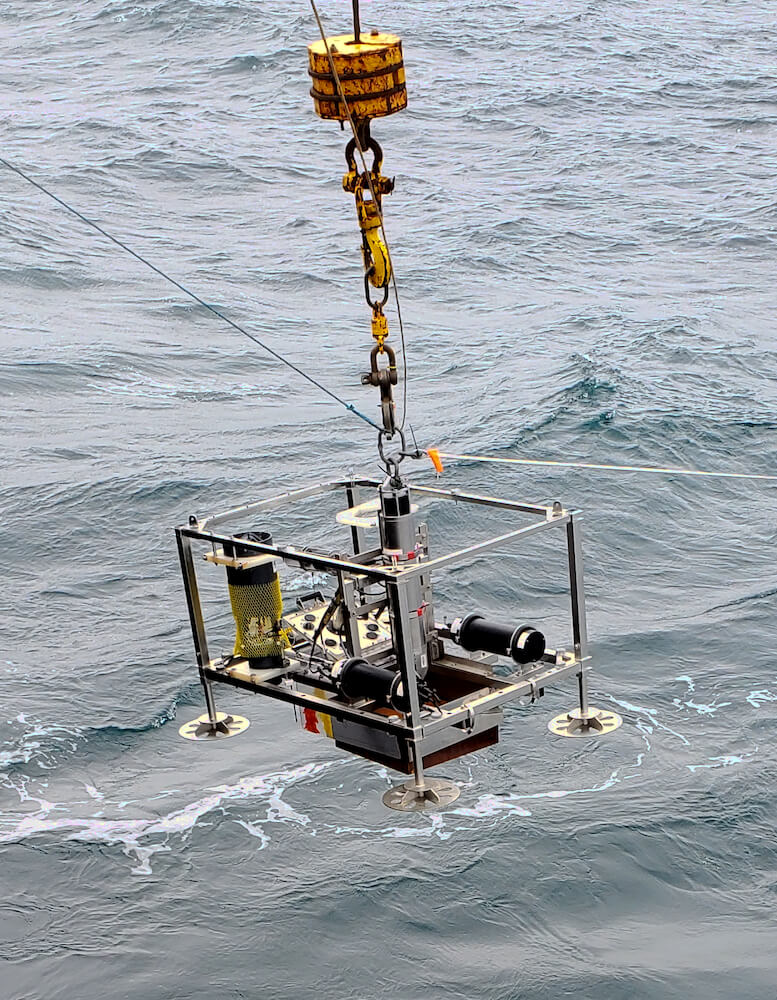
In seafloor sediments, biogeochemical reactions drive critical element cycles and sustain the structure and functioning of benthic and pelagic ecosystems. To understand these processes and observe their response to environmental changes and human impacts, scientists measure the exchange of critical compounds, such as oxygen, nutrients and carbon system parameters, into or out of the seabed. We have a developed a suite of new tools for measuring these benthic biogeochemical fluxes and studying the processes driving them.
A “benthic chamber lander” is an autonomous platform that is deployed on the seafloor, encloses a certain volume of water and sediment and monitors the changes in concentration of various compounds in the contained water volume over time. This lander allows to quantify the rate at which dissolved compounds are taken up or released by biological, microbiological or geochemical seafloor processes. Conventionally, these landers only measure oxygen and few other parameters autonomously with sensors, but the NOC lander has been augmented with lab-on-chip sensors to measure fluxes of a wider range of chemical parameters autonomously, including nutrients and carbonate system parameters.
The “ALPACAS” (Autonomous Lander system for Profiling And Chemical Analysis of Sediment) system is a lander for autonomous measurements of vertical profiles of dissolved chemical compounds in the upper seafloor sediments. Using lab-on-chip sensors, the instrument collects and analyses porewaters in adjustable increments of depth, with a current maximal resolution of 1 cm. It can alternatively be used to measure time series of a concentration of a dissolved compounds in porewater at several fixed depths of periods of hours and days.
Eddy Covariance
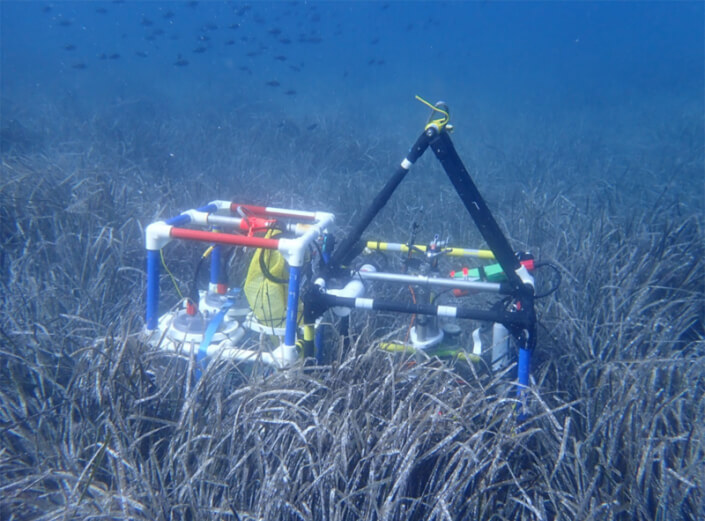
The aquatic eddy covariance technique uses high frequency measurements of turbulence and seawater chemistry to quantify the vertical transport of dissolved constituents (like oxygen and pH). This allows us to observe ecosystem processes at the seafloor from minute-to-minute. These measurements improve our understanding of how ecosystems grow and how they will respond to environmental change.
NOC are developing new sensors to expand the capabilities of this technique. For example, by coupling pH and oxygen eddy covariance, we have introduced a new monitoring capability for coastal and deep seafloor ecosystems like seagrasses, coral, shellfish, kelp, and others: observing the net calcification of all of the biota within them.
More Information
Koopmans, Dirk; Meyer, Volker; Schaap, Allison ORCID: https://orcid.org/0000-0001-5391-0516; Dewar, Marius; Färber, Paul; Long, Matthew; Gros, Jonas; Connelly, Douglas; Holtappels, Moritz.
2021
Detection and quantification of a release of carbon dioxide gas at the seafloor using pH eddy covariance and measurements of plume advection.
International Journal of Greenhouse Gas Control, 112, 103476.
10.1016/j.ijggc.2021.103476
2021
Article