


The Key to Effective Observing Networks
The tools available to marine science are vital in ensuring that observing networks function correctly and provide the most accurate data possible. NOC helps to develop these tools using cutting-edge technology and world-leading knowledge.
These tools are often multi-purpose and work alongside a range of other technologies to be applicable to some of the most used and wide-ranging observing networks used to learn more about our ocean.
Multisensor Communications Hub
The NOC OTE Sensor hub is a multi-purpose marine hub whose function is to enable integration of sensors with a variety of different platforms. The hub can distribute power and serial communications between a single input port (e.g. from a vehicle) and multiple output ports (e.g. to sensors; max 7 output ports). The hub is fully programmable and can solve a variety of sensor integration tasks, e.g.
- Power distribution
- Protocol translation
- Scheduling/synchronisation
- Data logging
- Vehicle port multiplexing
- Telemetry (using an external modem)
The small form factor, low power, full programmability, and full ocean depth rating make the sensor hub a uniquely powerful and versatile device in the field of marine research.
Specifications
| Parameter | Value |
| Input voltage | 12 V nominal, max 17 V |
| Sleep current | <100 μA |
| Idle current | 1.5 mA |
| Sensor port current limit | 4 A |
| Pressure rating | 600 bar |
| Number of RS232 sensor ports | 3, 5, or 6 (depending on hub variant) |
| Number of RS485 sensor ports | 1 (9-port hub variant only) |
Mooring Communication Systems
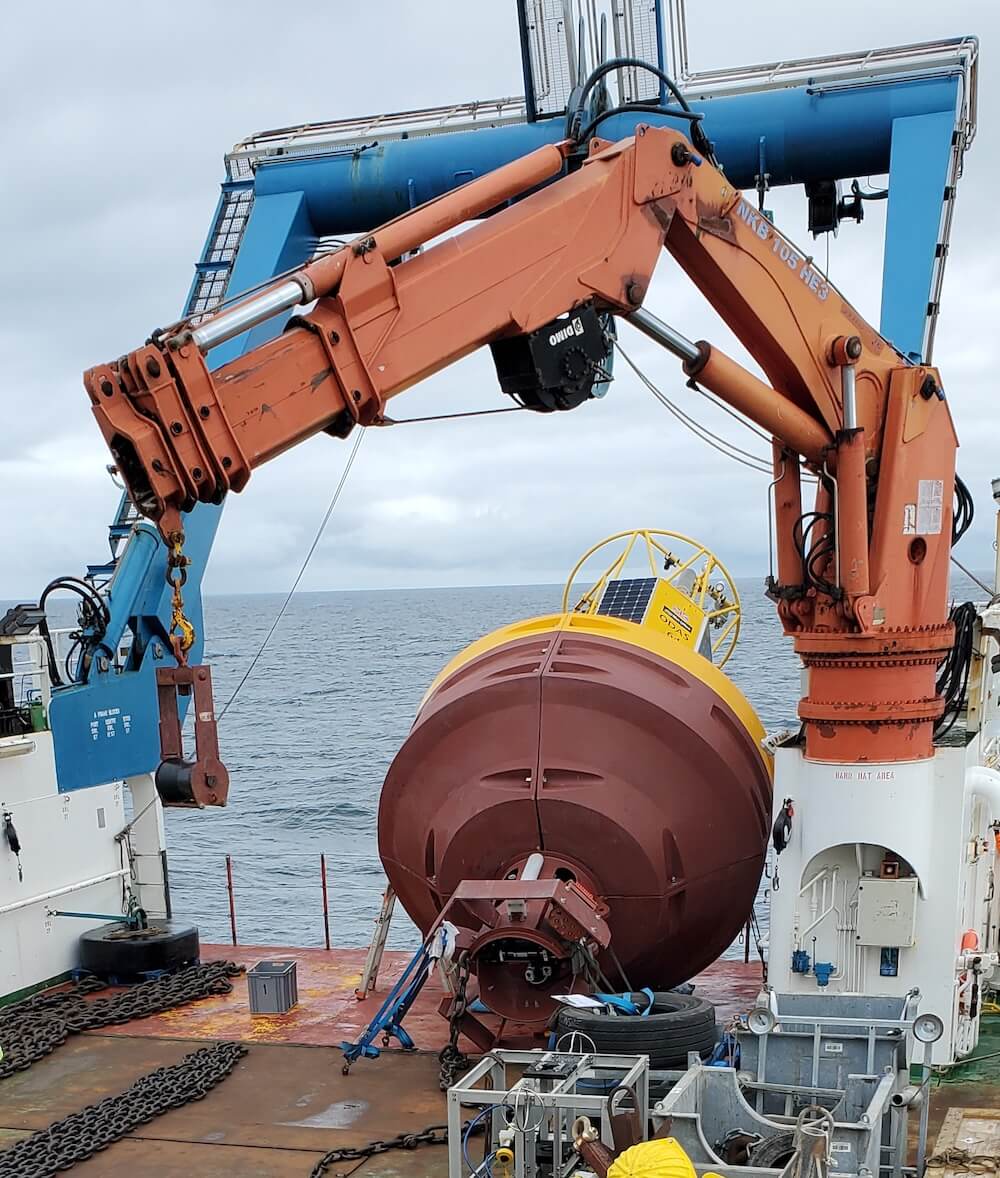
The most valuable part of any of our deployed systems is the data they collect. Moorings – observatories that are anchored at the seafloor and with instruments at various depths along a line above it – are often deployed for between 12 and 24 months between service visits. Sometimes, these infrequent service visits are the only time data are recovered. By reducing this delay we can both increase the scientific value of these data (by making it available to more users who need the data sooner) but also secure more of these data against loss of the mooring or other failures during that time.
To address this, we have been developing technologies to provide near-real-time data communications from the instruments along the mooring back to the user at shore. Our mooring communications systems have to be adapted for each application, but we have a toolbox of technologies we have tried and tested over the years for both moorings at the surface (Porcupine Abyssal Plain PAP1, where the system looks after power, individual instrument backup power, instrument control and overall system telemetry) as well as sub-surface only (RAPID array, instrument control and telemetry). Our communication strategies make use of satellite, acoustic, inductive and wired communications technologies, and for subsurface moorings we have the ability to communicate with research vessels, autonomous underwater vehicles, autonomous surface vehicles, or standalone equipment that can be carried aboard any other vessel.
We have also demonstrated 2 way control of subsea instruments from shore, including retrieving CTD measurements at 2700 m underwater from our office at NOC.