
Our day starts when the Megacore goes into the water, usually around eight at night. It takes more than three hours for the it to reach the seabed (roughly 4850 m deep) and return, so in the meantime, we ready our equipment and labels for sampling, have some food and prepare ourselves for a night full of mud!
The Megacore is made up of a metal frame and a sampling head with eight clear plastic core tubes (100 x 600 mm) attached to it. The corer is lowered on a (very long!) wire, we can see when it touches the seabed by a slight reduction in the tension of the wire. At that point, the core tubes slowly lower into the sediment, at a rate controlled by a hydraulic damper and lead weight on the head. Once withdrawn from the seabed, spring-loaded shutters close the bottom of the tubes to prevent the sediment slipping out, and the top is plugged to help minimise sample disturbance during recovery.
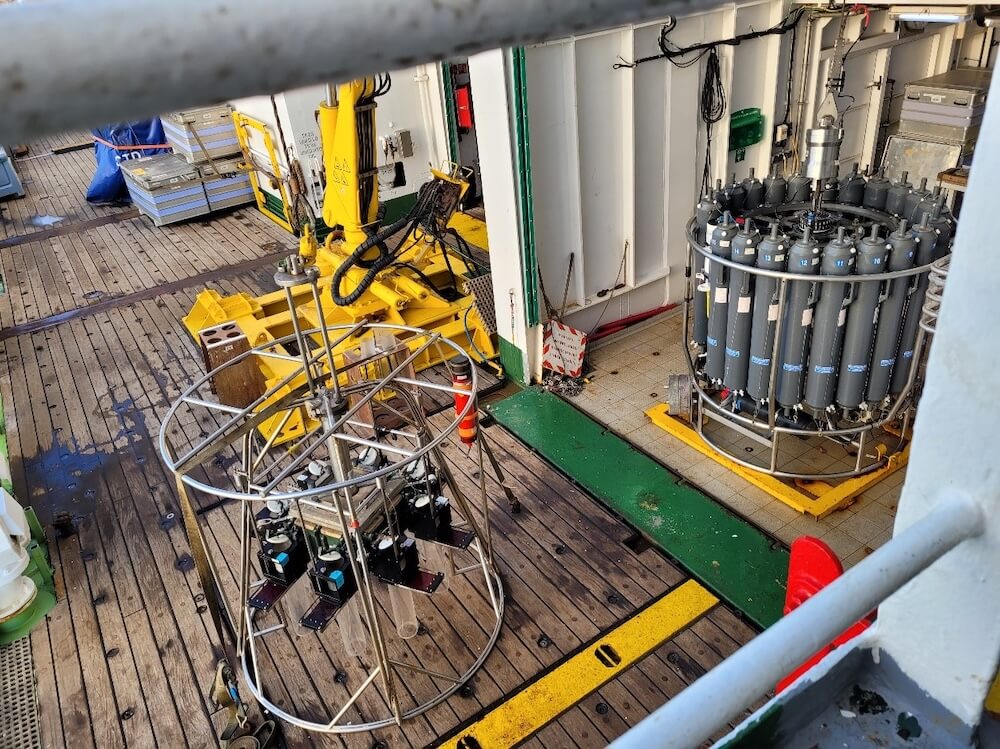
The Megacore on deck waiting for deployment.
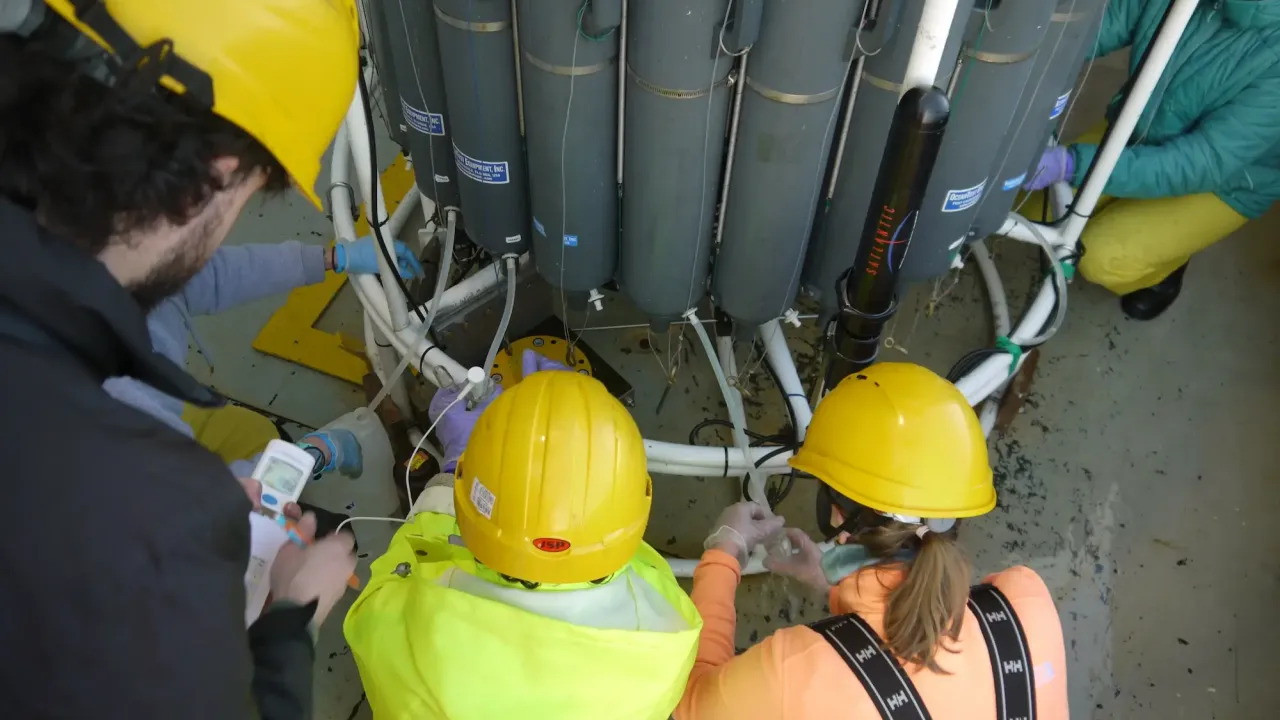
As the Megacore nears the surface, it is the beginning of a flurry of work for our team. Once recovered on deck it is important to document the success of the deployment (photographs and paper records), and to remove the sediment-filled core tubes as quickly and carefully as possible. Removing the tubes is a fiddly process requiring two people per tube, and our first priority is to firmly insert (and hold in) a bung at the base of the core so that our precious deep-sea mud doesn’t get away!
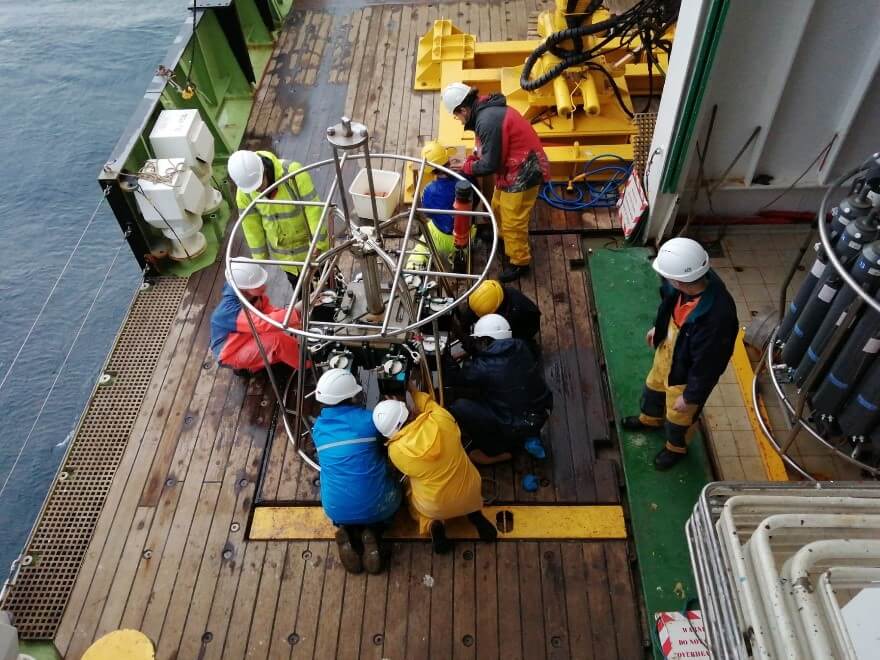
The benthic team retrieving sediment cores from an early-morning Megacorer recovery.
Once this first hurdle is overcome it is time to start processing our samples. The majority of the cores go towards the PAP-SO time-series, monitoring the diversity and abundance of benthic macrofauna. For this, each core must be extruded by placing it on a large plunger, and the top 5 cm is sliced off and preserved for later analysis of the invertebrates within it. These samples are particularly important as the PAP-SO time-series represents one of the only long-term datasets existing for the monitoring of benthic abyssal fauna. As such, it is of immense value for understanding long-term ecological dynamics and responses to environmental change.
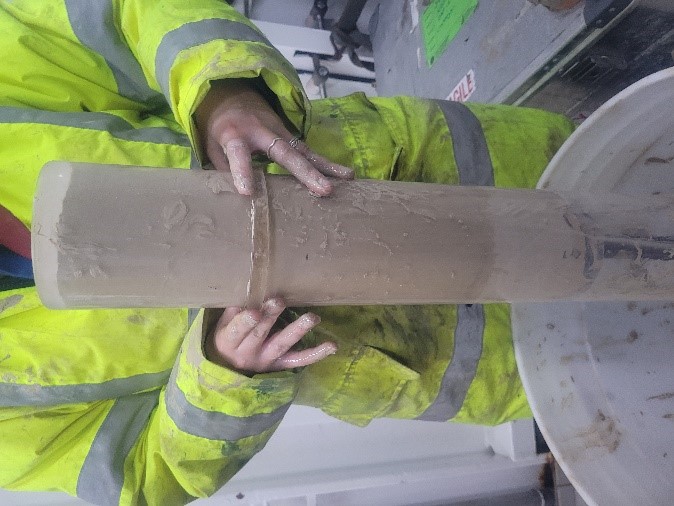
Sediment core being extruded for sampling different depth horizons.
In addition to the time-series samples, a number of cores were allocated for a variety of research projects. This year, we had several PhD students collecting sediment for ecological and biogeochemical analyses, as well as academics requiring sediment for geochemical and biotechnological research. Each different study focus requires the cores to be processed in a different manner, so we set up several stations to work through each one. When extruding the sediment, we often see signs of animal activity in the form of burrows extending from the surface, sometimes very deep into the core. This is evidence of an important ecological process known as bioturbation, and is of interest to some of our scientists. The mud is very light in colour and is soft and clay-like. Luckily for us, it is not as smelly as sediment samples from other environments can often be!
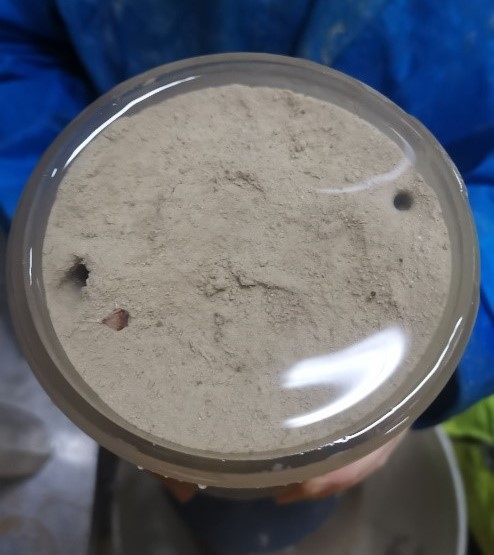
Overhead view of a sediment core showing burrow holes at the surface.
When all the sediment has been processed and preserved, it’s time to wash up our equipment and workspace, getting even muddier in the process. Once we have returned the core tubes to the frame, the Megacore is sent down again for a second deployment. The wait is then on for another few hours, before we do it all again!
Be part of the community helping our ocean thrive.