

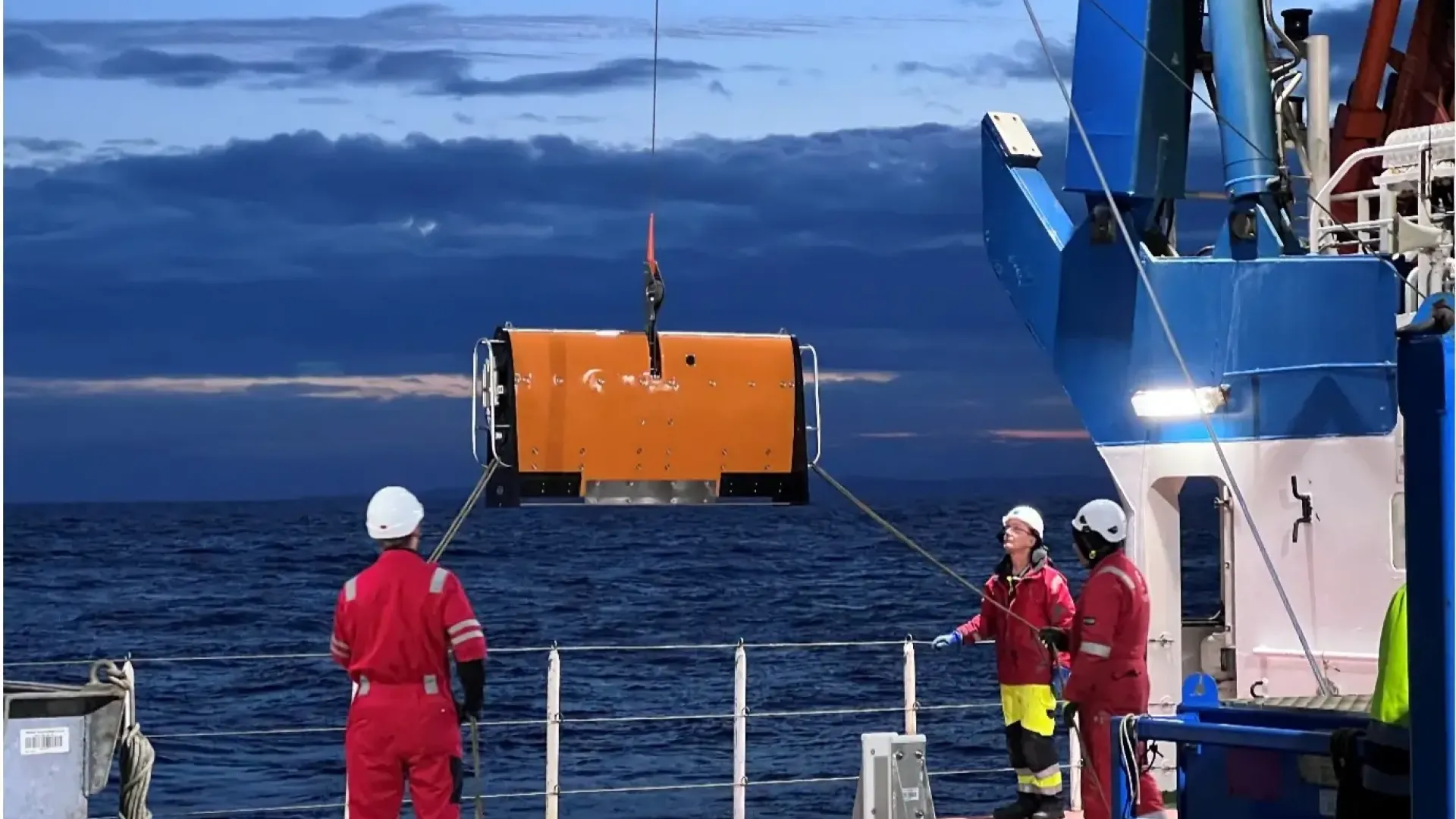
What are Towed Undulating Profilers?
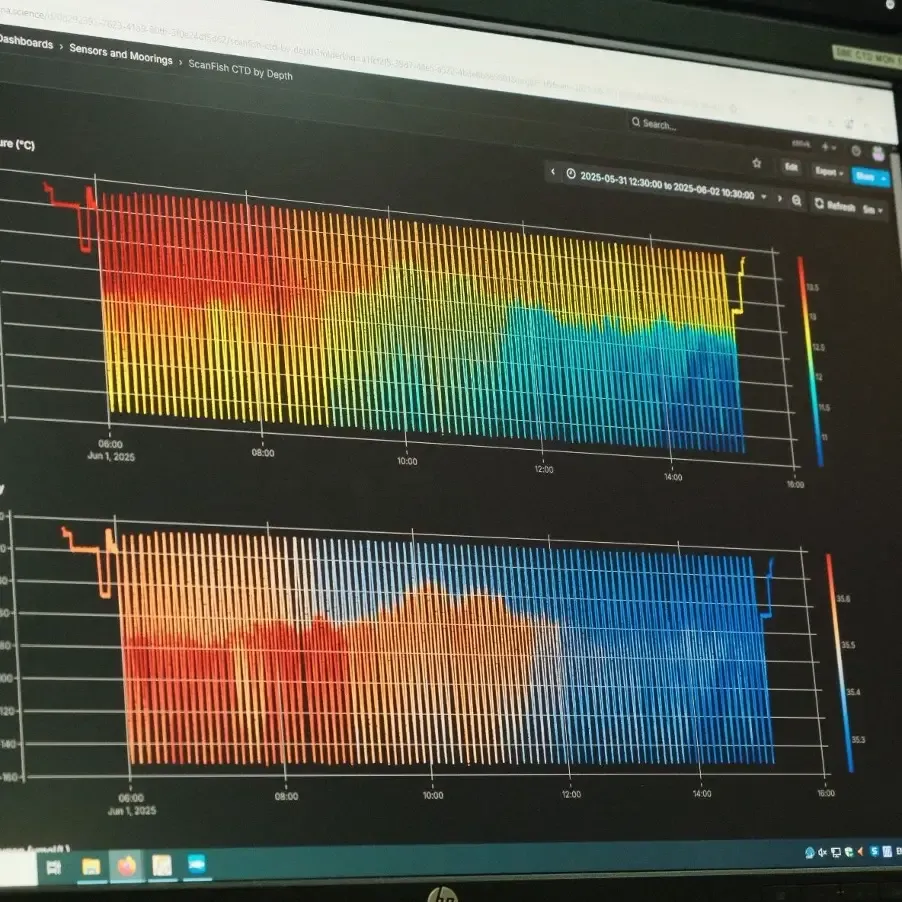
They are oceanographic systems that collect measurements of the upper ocean, while being towed behind a ship. These systems “fly” through the water in a repeated dive‑and‑climb pattern. They create a curtain‑like, three‑dimensional dataset that reveals the fine‑scale structure of the ocean over long distances.
These include the EIVA ScanFish III Rocio ROTV, the AML Oceanographic MVP300-1700 Moving Vessel Profiler and the CTG SeaSoar Mk II Vehicle.
How Do They Work?
These hydrodynamic vehicles are equipped with scientific sensors, and a cable linking them to the ship. As the vessel moves forward, the profiler is controlled to guide it in a smooth, up and down undulating motion.
This motion enables a continuous, high resolution survey of the upper few hundred metres of the water column. They can cover thousands of kilometres, resolving ocean features that stationary or widely spaced measurements would miss.
How Do These Tools Affect Our Understanding of the Ocean and Why Do We Use Them?
They have transformed our ability to observe the ocean by revealing intricate structures and rapidly evolving features that traditional sampling methods miss. They show a detailed and coherent picture of upper ocean dynamics.
They give a unique view of the ocean that no other platform can match. Their ability to collect, curtain like datasets while the ship is underway fills a critical observational gap in oceanography. Unlike other platforms, which offer discrete snapshots, towed undulating profilers produce seamless vertical profiles over an extensive range.
Why Are They Important Tools?
They bridge the space between:
- Ship based CTD transects, which have spatial gaps between profiles
- Moorings, which have limited spatial & temporal resolution
- Gliders and AUVs, which operate much more slowly
- Satellites, which cannot see below the surface
Their unique combination of swift horizontal speed, continuous vertical profiling, and high resolution sensing makes them the most effective tool for capturing the ocean’s complex variability.
Which Research Subjects is Their Use Strongly Linked?
They are primarily linked to research on sub mesoscale ocean dynamics. These are energetic, rapidly evolving features such as fronts, filaments, vortices, and topographic wakes. They occur in the upper ocean over scales of hundreds of metres to a few kilometres and evolve over hours to days. They act as a bridge between larger scale currents and small scale turbulence, influencing mixing, nutrient exchange, and biological patterns.
How Have Towed Undulating Profilers Been Used in Research?
They are used for research that requires a continuous, high resolution study of the upper ocean. They are especially valuable for studying sub mesoscale dynamics, physical oceanography, tidal cycle processes, and biogeochemical variability.
They are used in shelf seas, boundary currents, open ocean basins, polar regions, and major upwelling systems.
Researchers use these systems because they provide seamless, real-time, vertical profiles over an expansive area, with multi sensor measurements that link physical structure to ecosystem behaviour.
Future developments include improved sensors, smarter flight control, deeper operating ranges, and enhanced real time processing.
Over many decades, they have supported numerous projects investigating shelf sea processes, tidal cycle variability, sub mesoscale dynamics, eddies, stratification, and biophysical coupling across the North Atlantic, Pacific and Southern Oceans, and UK coastal waters.
During 2025, ScanFish III Rocio was used to track phytoplankton blooms (DY195 – ‘CARES’) and to look at mixing processes around offshore wind turbines (DY197 – ‘eSWEETS3’).
Research on shelf sea processes, mesoscale and sub mesoscale dynamics in the North Atlantic, Pacific and Southern Oceans, and UK coastal waters.
What are the Research Impacts of Using Towed Undulating Profiles?
They enhance our understanding of ocean–climate interactions by resolving elaborate structures that control heat exchange, carbon uptake, nutrient supply, and mixing in the ocean.
They improve our insight into ecosystem dynamics, linking physical oceanography features to patterns in phytoplankton, nutrients, oxygen, and light availability. This integrated view supports assessments of marine habitat health and productivity.
Without these profilers, many fast evolving upper ocean processes would be poorly observed or missed entirely, increasing uncertainty in climate predictions and biogeochemical assessments. The absence of such data would lead to weaker estimates of carbon cycling, nutrient distribution, and biological productivity.
Regions like boundary currents, upwelling zones, and polar edges are hotspots of rapid climate change. The lack of towed undulating profiler measurements would hinder our ability to understand and track changing ocean conditions.
What Have We Learnt From the Use of Towed Undulating Profilers?
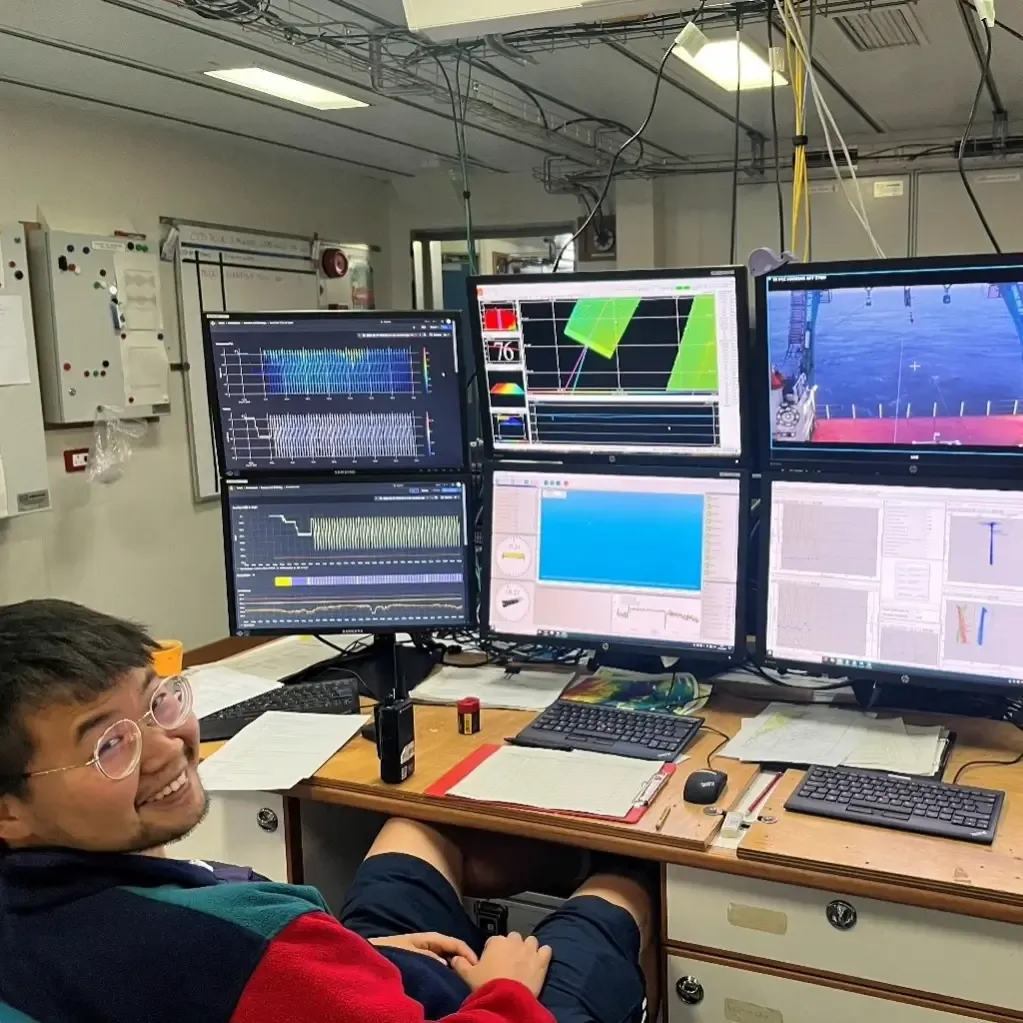
NOC scientists have used these datasets to improve their understanding of upper ocean stratification, eddy–front interactions, biophysical coupling, and the transport of heat, salt, oxygen, and nutrients. These datasets have been valuable for understanding how physical processes influence ecosystem structure across continental shelves, boundary currents, and polar regions. This helps to inform regulatory bodies and advice to government for policy decision-making.
How Are These Outcomes Related to Human or Marine Life?
Towed Undulating Profilers have contributed to NOC’s work on climate sensitive regions, offering detailed insights into rapidly changing marine environments that cannot be captured by other measurement platforms.