


Monitoring a Vital Ocean System
The global climate system is rapidly changing under anthropogenic greenhouse gas emissions, and a major mechanism of climate change associated with profound environmental, social and economic impacts is the Atlantic Meridional Overturning Circulation (AMOC).
The AMOC transports heat through the Atlantic, and climate and weather on the surrounding continents is sensitive to its mean state and variability. Furthermore the AMOC exerts significant control on the ocean’s sequestration of anthropogenic carbon. The Intergovernmental Panel on Climate Change (IPCC) projections have a declining AMOC over the next century, but at present the only way to know the state of the AMOC, and to assess the validity of climate models, is by observing it with moored arrays of which there are very few.
Since 2004 the UK and US have worked in partnership to implement the 26°N RAPID array. The array is simple in design but heavily dependent on research vessels. Recent developments in observing technology and process understanding provide an opportunity to test new approaches to observing the AMOC. We will design and test lower-cost, sustainable observing systems to provide AMOC estimates. Target stakeholders are researchers, forecasters, and decision-makers planning for the effects of climate change. The programme will be delivered in a partnership between UK (NOC, Met Office) and US (University of Miami and NOAA’s Atlantic Oceanographic and Meteorological Laboratory).
June 2023 – March 2026
Ben Moat
NERC – Strategic Research
Key Project Information
The aim of this proposal is to design a lower-cost and sustainable observing system at 26°N which will provide AMOC estimates at the accuracy and frequency required by users. This goal will be achieved by exploiting the progress made in understanding the AMOC variability as well as leveraging advances in observing methodology. Target stakeholders for the resulting data products are researchers, forecasters, and decision-makers planning for the present and future effects of human-forced climate change.
- Design, test and demonstrate the technological and scientific feasibility of lower-cost AMOC observing systems at 26°N that will provide data at prescribed accuracy and frequency.
- Identify the costs and benefits of a change in the array design by quantifying the resources and the accuracy of the data products for the present-day and alternate observing approaches.
- Develop a new methodology for producing data products from the optimal new array design identified in objectives 1. and 2., including a time series of the zonal velocity field at 26°N that will enable calculation of AMOC in density space as well as depth space, and facilitate the calculation of transports of different variables.
The outcomes from the three objectives above will allow us to deploy an optimised lower-cost 26°N AMOC array from 2027, with the UK component delivered as an underpinning activity in the NERC Long Term Large Scale Single Centre National Capability programme.
A system for the telemetry of data from moorings via an autonomous vehicle or ship has been developed. It has been successfully deployed on a mooring at the western boundary of the RAPID 26°N array during RRS Discovery expedition DY204 in December 2024. It has enabled data download from the RAPID array, which will provide greater data security and value to forecasters and researchers.













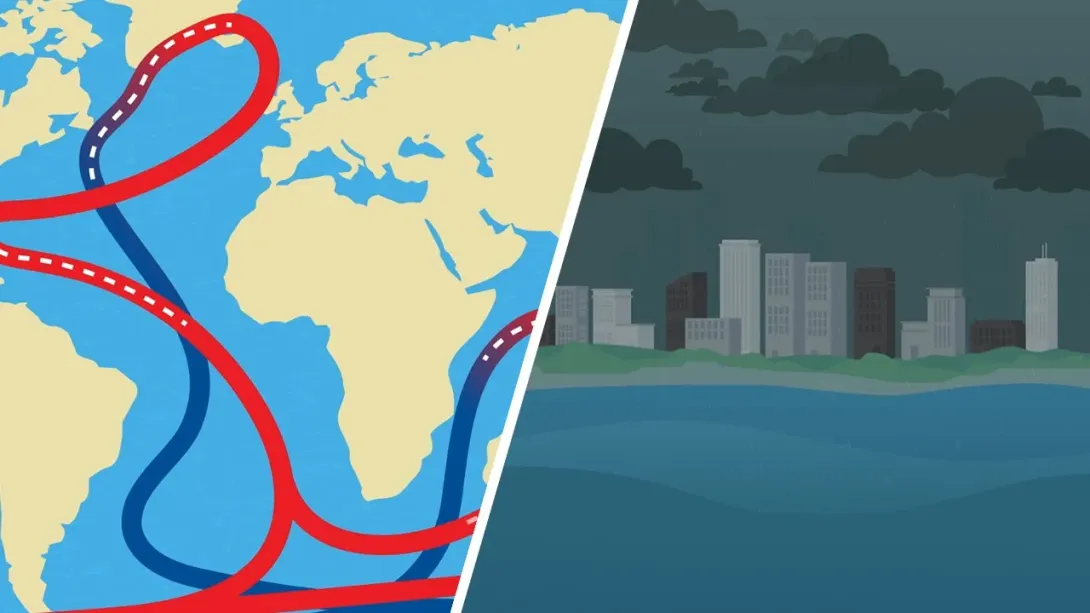
The Atlantic Meridional Overturning Circulation (AMOC): What Is It and Why Is It So Important?

Rapid Publications
Check out our recent Rapid publications
McCarthy, Gerard D.  ORCID: https://orcid.org/0000-0002-2363-0561; Hug, Guillaume ORCID: https://orcid.org/0009-0009-7343-6562; Smeed, David ORCID: https://orcid.org/0000-0003-1740-1778; Morris, Kirsty J.; Moat, Ben ORCID: https://orcid.org/0000-0001-8676-7779.
2025
Signal and noise in the Atlantic Meridional Overturning Circulation at 26°N.
Geophysical Research Letters, 52 (7).
10.1029/2025GL115055
ORCID: https://orcid.org/0000-0002-2363-0561; Hug, Guillaume ORCID: https://orcid.org/0009-0009-7343-6562; Smeed, David ORCID: https://orcid.org/0000-0003-1740-1778; Morris, Kirsty J.; Moat, Ben ORCID: https://orcid.org/0000-0001-8676-7779.
2025
Signal and noise in the Atlantic Meridional Overturning Circulation at 26°N.
Geophysical Research Letters, 52 (7).
10.1029/2025GL115055
2025
Article