

The large UK Met Office buoy was deployed at PAP-SO (Porcupine Abyssal Plain Sustained Observatory) on Friday, 31 May 2024. As well as meteorological measurements, we have added atmospheric greenhouse gas measurements, and year-round biogeochemical measurements in the surface and sub-surface waters. One of the core measurements is carbon dioxide (see below figure), that we measure to the high standards required by ICOS (Integrated Carbon Observation System [1]). ICOS operates across the Atlantic and Europe, linking the atmosphere, ocean, and land measurements of greenhouse gases.
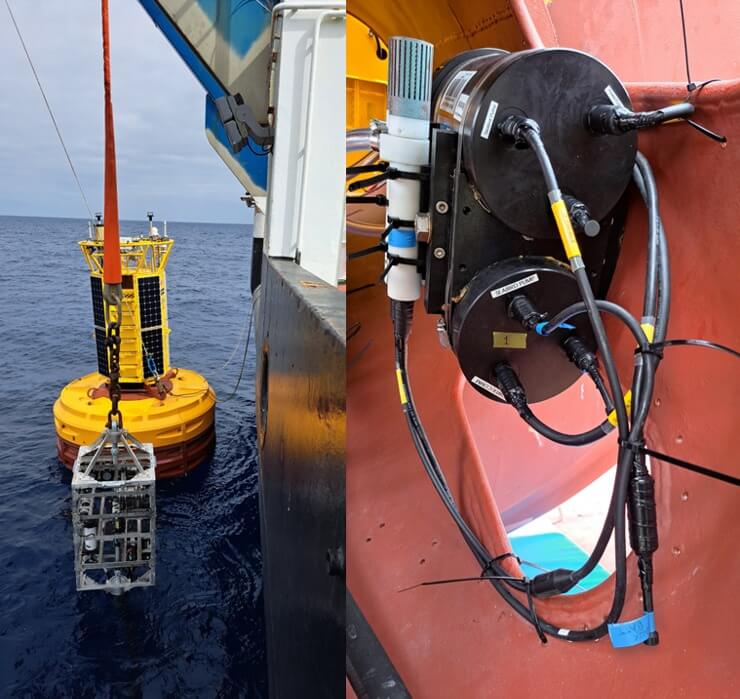
Deployment of Met Office buoy and sensor frame; ProOceanus pCO2 sensors fitted to the keel of the buoy. Photos © Andrew Gates.
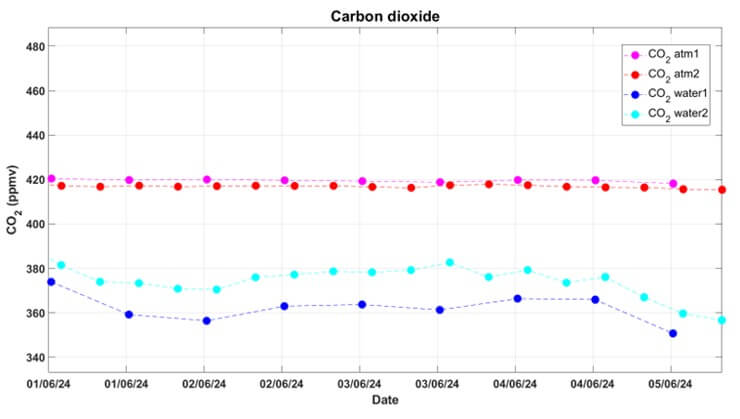
Latest pCO2 values measured by these sensors in seawater and the atmosphere.
Understanding changes in carbon dioxide flux also requires accurate measurements of the sea surface temperature, salinity, and other gases such as dissolved oxygen. The RRS James Cook has also been fitted with state-of-the-art instruments for continuous carbon dioxide measurements that will be compared with PAP-SO autonomous measurements.
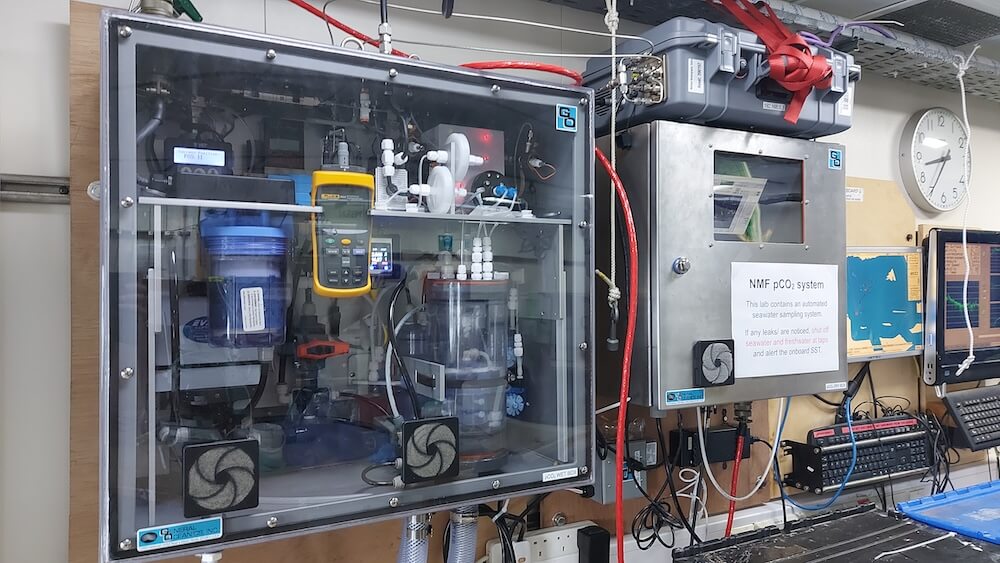
New state-of-the-art GO210 underway pCO2 system on the RRS James Cook. Photo © Anita Flohr.
In this region of the Atlantic, the spring phytoplankton is associated with a large change in carbon dioxide, so we take additional measurements of the inorganic nutrients and chlorophyll to understand the timing and magnitude of phytoplankton blooms throughout and between years. The system is autonomous and will continue to collect data after we have left the site, and data will soon be available [2].
We are actively involved in projects aiming to improve our core measurements and make them more comparable between other ocean ‘stations’. MINKE is an EU start up community (Minke – Metrology for Integrated marine maNagement and Knowledge-transfer nEtwork), putting the techniques of metrology at its core, improving the standards, and making inter laboratory comparisons [3]. This impacts the carbonate chemistry (including carbon dioxide and pH), dissolved oxygen, chlorophyll, and salinity measurement that we make at the PAP-SO. On JC263 we are taking some additional samples for improved measurements of chlorophyll-a and other pigments. These will indicate the phytoplankton communities around this region of the productive northeast Atlantic. These ‘HPLC’ samples are collected as part of a MINKE ‘trans-national access’ partnership with analysis at a laboratory in France (read more about the MINKE project in a recent Frontiers paper [4]).
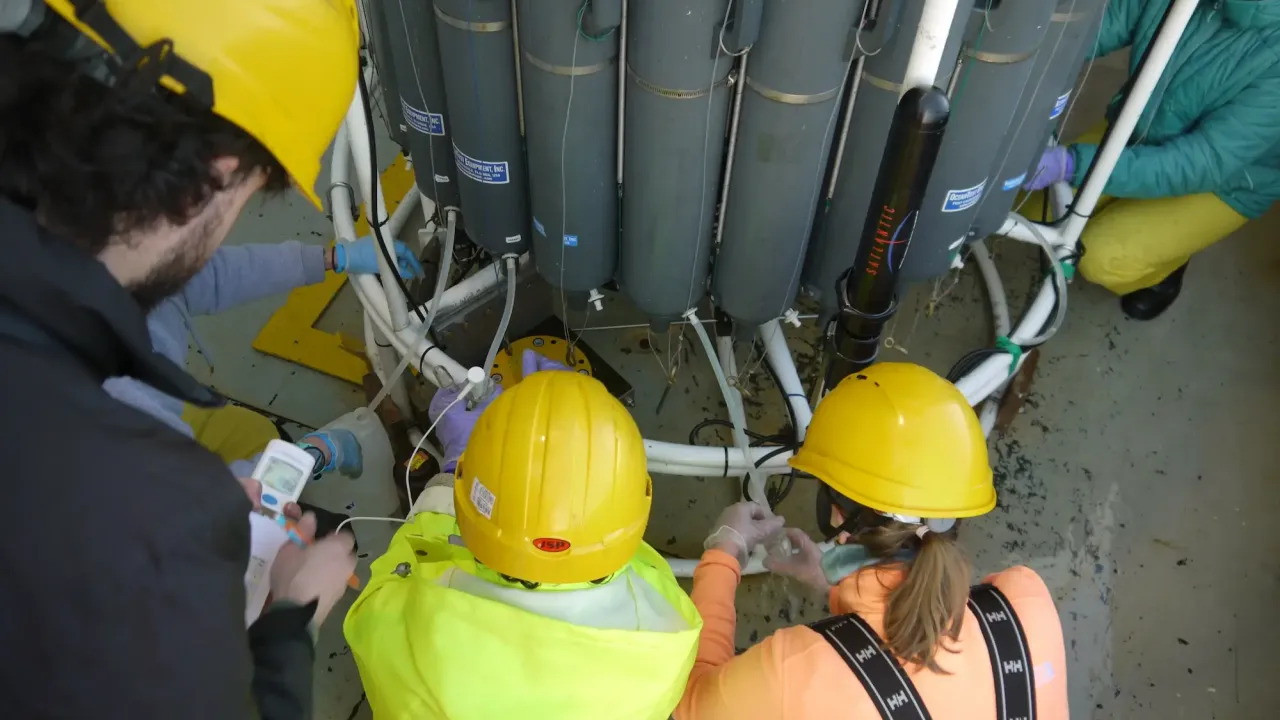
The biogeochemistry team onboard are busy collecting further samples for analysis onboard and ashore at the National Oceanography Centre. These will be used to validate the data measured using the various sensors and samplers at PAP-SO that will autonomously collect data for a year. For example, to help ground-truth the oxygen-based estimates of productivity from the PAP mooring, we are taking daily profiles of primary production and nitrate uptake to capture productivity rates across the euphotic zone during peak spring bloom conditions and to track productivity.
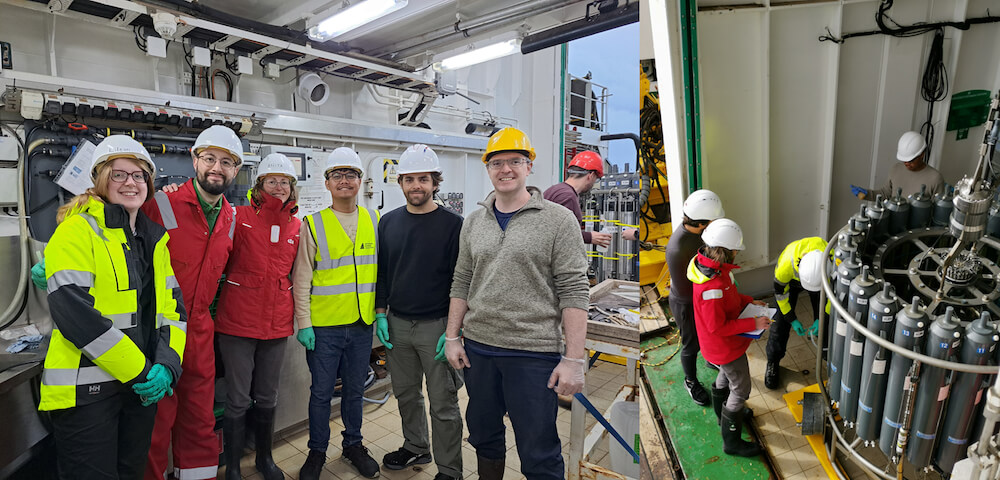
Left: The JC263 Biogeochemistry team (from left to right: Eilean MacDonald, Anthony Lucio, Anita Flohr, Rizky Muliawan, Christopher Feltham, and Stuart Painter. Right: Water sampling from the CTD rosette. Photos © Andrew Gates (left) and Lucy Goodwin (right).
Links:
[2] https://projects.noc.ac.uk/pap/
[4] https://www.frontiersin.org/articles/10.3389/fmars.2023.1192030/full
Be part of the community helping our ocean thrive.