

Researchers at the National Oceanography Centre (NOC) have completed a global-scale assessment of large-scale macroalgae (seaweed) cultivation as a marine carbon dioxide removal (mCDR) strategy, revealing both its potential for mitigating climate change and its environmental trade-offs.
The study, led by Prima Anugerahanti and published in Biogeosciences, used the NEMO-MEDUSA ocean biogeochemical model to investigate how extensive seaweed farming could influence the global carbon cycle, ocean chemistry and marine ecosystems under a range of cultivation scenarios.
Marine carbon dioxide removal approaches are receiving growing attention as potential tools to help limit climate change alongside the significant emissions reductions required.
Macroalgae cultivation has been proposed as one such approach because seaweed absorbs carbon dioxide during growth and could, in principle, remove carbon from the atmosphere if harvested biomass is transferred to the deep ocean for long-term storage.
The modelling study found that large-scale cultivation could substantially increase the transfer of carbon dioxide from the atmosphere into the ocean.
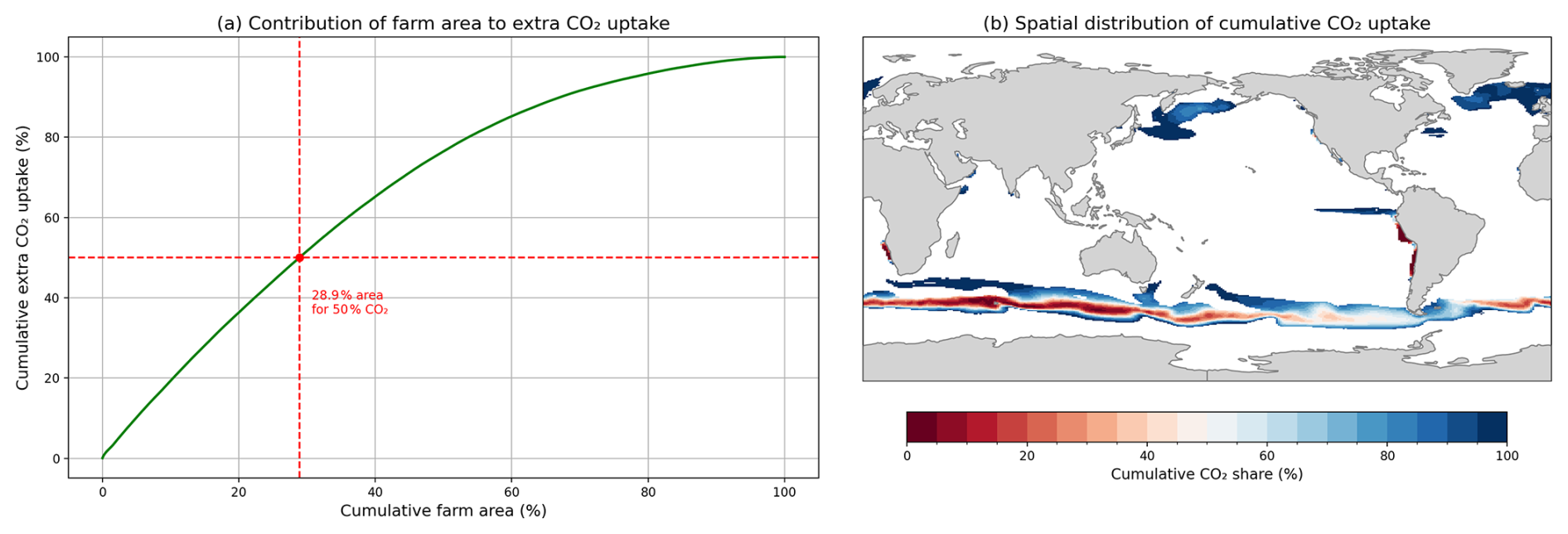
Image above shows large variation in CO2 uptake within macroalgae cultivation areas. (a) Model grid cells are sorted by their quantitative contributions to additional CO2 uptake and then the associated cultivation area and CO2 uptake are accumulated. (b) Geographical distribution of cultivation area which contributes the most to additional CO2. Deep red regions are those that contribute most to CO2 uptake, while deep blue regions contribute least.
Under scenarios where seaweed growth was supplemented with iron, the model simulated increases in ocean carbon uptake of up to 11 petagrams of carbon per year (that equals around 11 billion metric tons of carbon per year). While this increase is comparable to anthropogenic emissions (10.3 Pg C y-1 in 2024), only around 27% of the carbon within the cultivated macroalgae ultimately contributed to carbon removal, highlighting limitations in the overall efficiency of the approach.
Our study shows that large-scale macroalgae cultivation has the potential to enhance ocean carbon uptake, but it also demonstrates that the amount of carbon ultimately removed is actually much smaller than the total amount within seaweed biomass. The results highlight both the opportunities and the challenges associated with scaling up this approach.
Prima Anugerahanti, a Senior Research Scientist at NOC and lead author
The research also identified significant ecological consequences. In the model simulations, competition for nutrients between cultivated macroalgae and naturally occurring phytoplankton reduced surface nutrient concentrations by more than 50%. This led to large declines in the productivity of the phytoplankton in the ocean, with the result that their abundance, and that of the animals who eat them, also significantly declined.
Co-author Andrew Yool, a Senior Research Scientist at NOC, added: “The ocean is an interconnected system, so introducing very large-scale seaweed cultivation doesn’t only affect carbon cycling. Our simulations indicate substantial changes to background ocean biogeochemistry, including nutrient distributions, primary production and ecosystem structure, and these would doubtless impact fisheries and natural populations not in our model. Understanding these wider consequences is essential when evaluating any proposed carbon removal method.”
Scenarios involving the harvesting and deep-ocean deposition of seaweed biomass produced further impacts. Global seafloor oxygen concentrations declined by more than 20% in some scenarios, with areas of low-oxygen conditions expanding substantially, particularly in regions where macroalgae biomass was deposited.
The results were highly sensitive to cultivation strategies and model assumptions. More frequent harvesting improved carbon removal efficiency but increased the risk of oxygen depletion at depth. The study also found that cultivation without additional iron supplementation was ineffective as a carbon removal strategy, in some cases resulting in a net release of carbon dioxide back to the atmosphere.
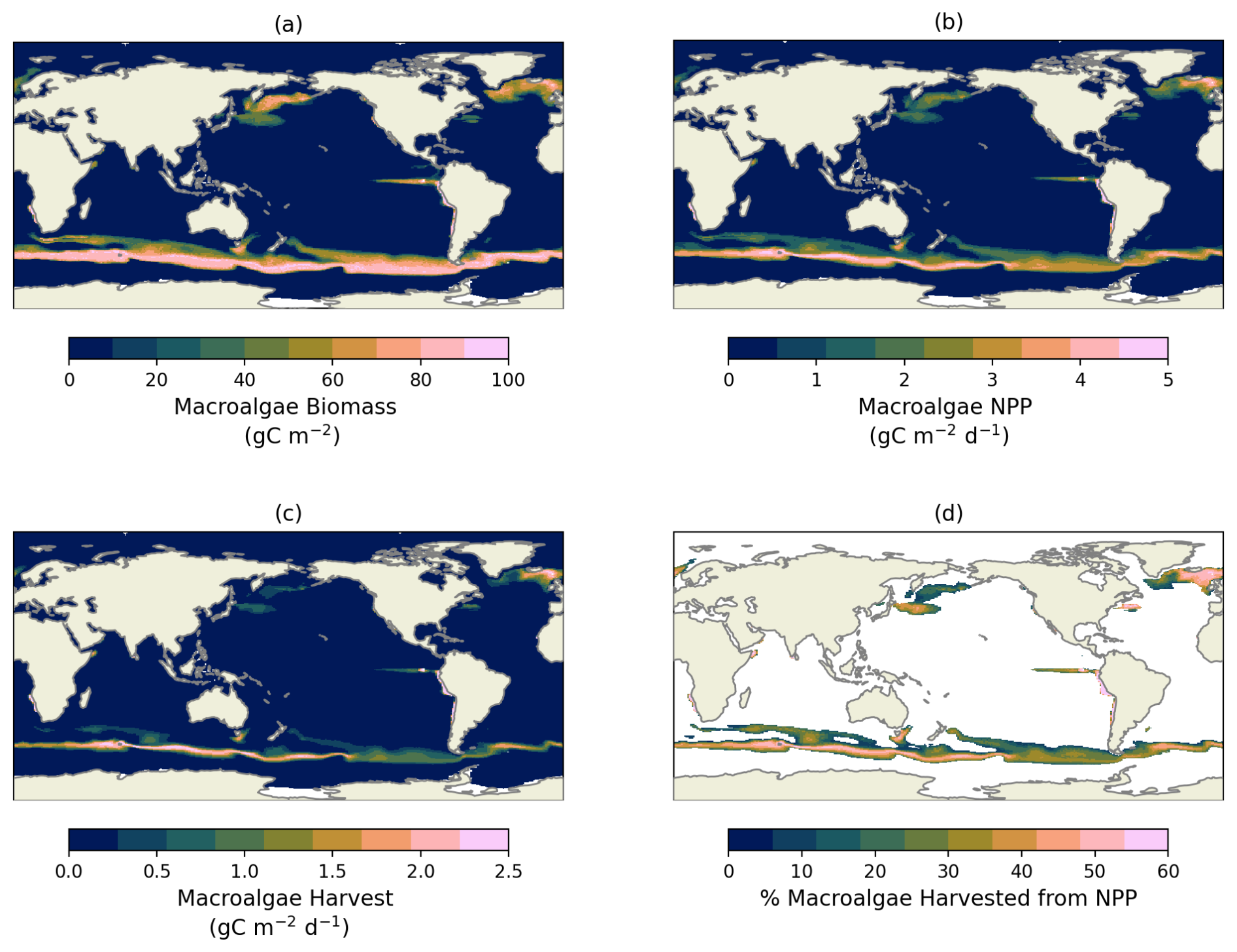
Above charts show: Macroalgae Biomass (a), NPP (b), harvest (c), and percentage of how much NPP are harvested (d) from the default experiment averaged between 2015–2024.
Co-author Chelsey Baker, a Senior Research Scientist at NOC, said: “Our findings underscore that macroalgae cultivation should not be viewed as a standalone solution to climate change. While it may have a role to play, effective climate mitigation is likely to require a portfolio of carbon dioxide removal approaches, both marine and land based. Most importantly, drastic emissions reductions are fundamental for there to be meaningful mitigation of climate impacts.”
The authors conclude that large-scale macroalgae cultivation alone is unlikely to provide a viable solution for marine carbon dioxide removal. Instead, future climate mitigation efforts will likely require a portfolio of complementary approaches, including other marine carbon dioxide removal techniques such as ocean alkalinity enhancement.
The research was supported by the UK Research and Innovation (UKRI) projects AtlantiS and TerraFIRMA, and was completed just in time for Prima and her family to welcome the arrival of her new son, Joseph.
Be part of the community helping our ocean thrive.