

Limiting warming could help protect one of the ocean’s most important ecosystems, according to new research led by the National Oceanography Centre (NOC).
The study finds that restricting warming to around 1.5–2°C could give the North Atlantic’s spring phytoplankton bloom a pathway towards long-term recovery. However, if warming rises beyond this level before global emissions reach net zero, the bloom could continue to decline for centuries.
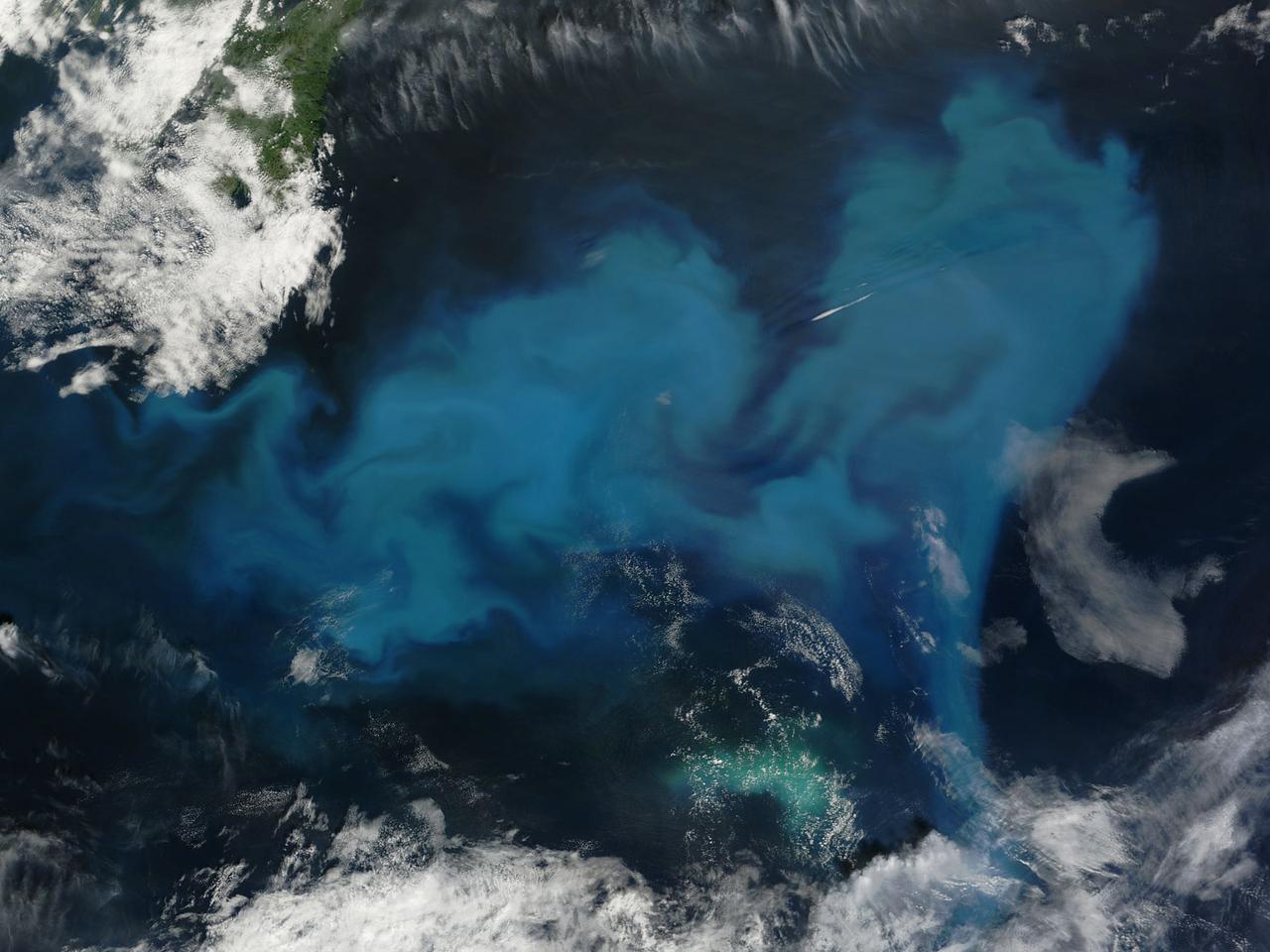
Image: NASA/GSFC/Jeff Schmaltz/MODIS Land Rapid Response Team
Published in the Journal of Geophysical Research, the research used the UK Earth System Model (a climate modelling tool) to explore how the North Atlantic subpolar gyre and its phytoplankton bloom might respond to different levels of global warming and subsequent climate action.
The North Atlantic subpolar gyre is a region just south of Greenland where intense winter storms cool the ocean surface, causing surface waters to sink to great depths in a process known as deep convection. This annual overturning brings nutrient-rich deep waters back towards the surface, fuelling the annual spring phytoplankton bloom, one of the largest seasonal biological events in the ocean.
Phytoplankton are microscopic organisms that form the foundation of the marine food web, supporting ecosystems that include fish, seabirds and marine mammals.
Climate change is expected to weaken deep convection, due to ocean warming and increasing freshwater input. Some studies suggest that, if these changes become sufficiently large, deep convection could weaken abruptly, representing a potential climate tipping point for the subpolar gyre.
A reduction in deep convection would limit the supply of nutrients to surface waters, reducing phytoplankton growth and potentially affecting marine ecosystems and the ocean's ability to absorb carbon dioxide.
The research demonstrated that that if warming peaks at around 1.5°C before emissions reach net zero, the North Atlantic bloom can begin to recover towards pre-industrial conditions.
However, when net zero is reached after warming of around 2.5°C or more, the modelled bloom continues to decline rather than recover, suggesting a potential tipping threshold somewhere between 1.5°C and 2.5°C of global warming, beyond which net zero may not be enough to stop the decline of the North Atlantic bloom.
The encouraging message from this study is that there is a pathway towards recovery. Limiting global warming gives the North Atlantic ecosystem a much better chance of recovering in the long term. However, our results also show that the ocean operates on timescales much longer than our own lifetimes – even under the most favourable scenarios, recovery takes centuries.
Lead author Dr Sophy Oliver, National Oceanography Centre
The researchers also explored scenarios involving negative emissions, in which carbon dioxide is actively removed from the atmosphere by the deployment of carbon dioxide removal (CDR) technologies. These experiments suggest that negative emissions could eventually enable recovery at higher levels of warming.
However, while they are actively being researched, the CDR technologies required to achieve negative emissions at the necessary scale do not currently exist.
Dr Andrew Yool, senior scientist and a model expert at the National Oceanography Centre, said: “These experiments help us understand how the ocean might respond to different climate pathways and, importantly, how much opportunity we have to influence those pathways. They underline the risks of relying too heavily on future technologies that are not yet available at scale. Reducing emissions still remains the most direct and reliable way to limit the risks to ocean ecosystems and the wider climate.”
The study also found that recovery is slow, even in the most favourable scenarios. This highlights the importance of limiting warming early, rather than relying on the ocean to rapidly recover once emissions are reduced.
NOC principal scientist Dr Katya Popova, an expert in the impacts of climate change on marine ecosystems, commented: “This work highlights the need to assess broader ecosystem consequences, including effects on the marine food web and carbon storage. Changes in the gyre do not stay in the gyre and they may serve as an early warning indicator to wider ecosystem impacts, allowing for more timely adaptation to changing ocean conditions.”
The researchers emphasise that the study uses idealised model experiments from only one Earth system model. Further experiments across a wider range of models will be needed to build a more robust picture of how the gyre and bloom may respond to different emissions scenarios, and what the wider ecosystem consequences may be.
Fortunately, collaborations between international modelling groups are beginning to reproduce these experiments across a diverse range of different models to help us better understand just how sensitive the Earth is to when we achieve net zero.
The research was led by the National Oceanography Centre, with support from Plymouth Marine Laboratory, the UK Met Office and the National Centre for Atmospheric Science, University of Reading. It was funded by the NERC projects TerraFIRMA, UKESM and AtlantiS, the EU-funded OptimESM and TipESM projects, and PROMOTE, funded by ARIA.
Notes to editors
Publication
Oliver, S., Yool, A., de Mora, L., Kelly, S., Liddicoat, S. K., Loveridge, A., Smith, R. S., Popova. E. (2026). The North Atlantic subpolar gyre and phytoplankton bloom under potential future climate scenarios. Journal of Geophysical Research: Oceans, 131, e2025JC023561. https://doi.org/10.1029/2025JC023561.
Research institutions
The research was led by the National Oceanography Centre (NOC), with contributions from Plymouth Marine Laboratory (PML), the UK Met Office and the National Centre for Atmospheric Science (NCAS), University of Reading.
The study used the UK Earth System Model (UKESM1) to conduct idealised experiments exploring the response of the North Atlantic subpolar gyre and phytoplankton bloom to different global warming and emissions pathways.
The work was supported by the NERC-funded TerraFIRMA, UKESM and AtlantiS projects, the EU-funded OptimESM and TipESM projects, and PROMOTE, funded by ARIA.
Be part of the community helping our ocean thrive.