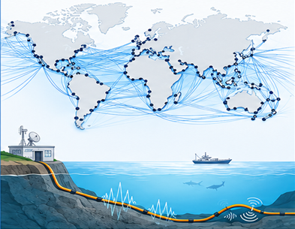
Scientists at the National Oceanography Centre (NOC) have shown using passive marine noise, that subsea fibre-optic cables can reveal variations in how they interact with the seabed. The research opens a pathway from protecting critical infrastructure to reliable, planet-scale environmental observations.
The study, by Professor Mohammad Belal and Dr Hamid Shiri at NOC, was recently published in Scientific Reports, part of the Nature family of journals. https://doi.org/10.1038/s41598-026-59846-4
The new method, called Poincaré spectral coherence, draws on the Poincaré inequality, a mathematical principle that places an upper bound on how much a quantity can fluctuate around its spatial average. Building on this relationship, the researchers developed a measure of spatial regularity that compares how consistently neighbouring sections of fibre respond across different acoustic frequencies. Buried or firmly supported cables tend to produce smoother, more coherent patterns, whereas exposed or weakly supported sections are more irregular. These differences indicate how well a cable is coupled to the seafloor, rather than a direct measure of burial depth or structural integrity. Furthermore, the approach is computationally lightweight and does not require controlled sound sources or prior geological surveys, making Poincaré spectral coherence a practical starting point for near-real-time assessment of submarine cable conditions.
From critical submarine cabled infrastructure to ocean sensors
More than 1.5 million kilometres of subsea telecommunications cable are in service worldwide, carrying data between continents. Scientists are increasingly exploring how these fibres can also act as continuous arrays of environmental sensors. Using a technique called distributed acoustic sensing (DAS), they can detect signals from waves, currents, earthquakes, marine life and human activity.
However, a fundamental difficulty stands in the way. A cable does not observe the ocean independently of its surroundings. What it records also depends on whether it is buried, supported or exposed on the seabed. Without accounting for this, a change in how sensitive the cable is could be mistaken for a change in the ocean itself. The Poincaré spectral coherence method addresses this issue.
The team tested the framework using field recordings from two sites: the European Marine Energy Centre (EMEC) at Eday, Orkney, and the OBSEA coastal observatory near Barcelona. At both, the patterns it detected were consistent with the known geology and with independently reported burial and exposure conditions.
Professor Belal said: “This study represents a breakthrough in our understanding of the data collected by underwater cables. How the cables rest on, or are buried in, the seabed influences everything we measure. By beginning to characterise that interaction we create a foundation both for more trustworthy environmental observations and for a better understanding of the physical condition of infrastructure on which society depends.”
Protecting critical submarine-infrastructure and improving ocean observations
Beyond environmental monitoring, the ability to identify changes in cable-seafloor coupling could help telecommunications and offshore energy operators locate potentially vulnerable sections of critical subsea infrastructure, enabling targeted inspections, preventative maintenance and improved cable protection.
The research lays the groundwork for self-calibrating ocean observatories. This means the infrastructure can continuously check and correct itself, making its environmental measurements far more reliable over time. This could help transform the global telecommunications network, much of which already exists, into a low-cost, planetary-scale platform for long-term climate research, ocean observation, and early warning of geological hazards such as underwater earthquakes and landslides.
Improved confidence in oceanographic measurements could enhance our understanding of climate-related processes and change, while more reliable interpretation of biological signals could support biodiversity research, including studies of cetacean activity, distribution and the effects of marine noise on marine ecosystems.
It allows low-cost, real-time observational attributes which can be further developed to meet the growing demand for providing quantifiable insights into burial depth, cable damage or structural integrity, faults-prediction, assessing structural health or detecting deliberate interference.
Towards a self-calibrating ocean observing network
The next stage is to test how well the approach scales across longer cables and contrasting ocean environments. The team’s planned pathway includes a cable of around 80 km near Madeira in the subtropical North Atlantic, and Mediterranean cables of around 30 km and 100 km. Ultimately, it extends to subpolar North Atlantic systems spanning hundreds to thousands of kilometres. This will also require independent seabed and ocean measurements to corroborate and/or ground-truth lasting cable effects from changing ocean conditions.
Dr Shiri said: “This approach extracts useful information from the spatial organisation of signals already recorded by the fibre. Because the calculations are relatively light, they offer a practical starting point for near-real-time assessment. The opportunity now is to test that information across much longer cable routes and very different marine conditions.”
“The longer-term ambition is a network of self-characterising cables. These would recognise the conditions shaping their own measurements and use that knowledge to interpret signals from waves, currents, earthquakes and ecosystems more reliably.”
Self-calibration at network scale is a goal of NOC’s wider research programme, not a capability demonstrated by this study. Across the global cable network, it could enable consistent, long-term environmental intelligence for ocean science, climate research and hazard awareness.
The study builds on NOC’s wider research into Ocean Fibre Sensing using subsea cables, supported by UKRI, ARIA, Trans-National EU projects such as: SHARC, WOTAVSESC, AtlantiS, NSFGEO-NERC, SEALS and Full Ocean Fibre.
Paper: Shiri, H. & Belal, M. (2026). A real-time framework for mapping subsea cable burial state using Poincaré spectral coherence of DAS measurements. Scientific Reports 16, 23647. https://doi.org/10.1038/s41598-026-59846-4
Funding: NERC grants NE/Y003365/1 and NE/Y005589/1. Field-campaign support from SHARC and JERICO-S3 (FISHES/SeaHORSE).
Be part of the community helping our ocean thrive.