


50 Years of the Ellett Line
For 50 years, the Ellett Array (previously the Ellett Line) has provided one of the most important and enduring records of change in the North Atlantic Ocean.
Stretching between the west coast of Scotland and the North Atlantic, it provides an internationally important data set to help better understand our climate and how it is changing. It is one of the most successful long-term ocean observing systems still in place today.
Since 1975, scientists have been regularly returning to measure temperature, salinity, currents, chemistry and marine life. Though the original line has changed – from solely the Rockall Trough in the 1970s to now reaching as far as the middle of the Iceland Basin - one thing has remained the same, it’s importance to marine science.
The observations from the Elley Array reveal how the ocean is changing, how those changes influence climate and ecosystems, and why the North Atlantic matters to communities across the UK and beyond.
Expedition Diary
| Ship | Duration | Departs | Returns | General Location | Chief Scientist |
| RRS Discovery | 20/8/26 - 9/9/26 (20 days) | Southampton, UK | Glasgow, UK | Northeast North Atlantic | Dr Tiago Segabinazzi Dotto |
To mark more than 50 years of the Ellett Line, the National Oceanography Centre (NOC) and the Scottish Association for Marine Science (SAMS) are going behind the scenes at the latest voyage to the region, charting the journey aboard RRS Discovery.
During the voyage, scientists will be recovering moorings that stayed in the water for the last two years, re-deploying new moorings that will stay in the water for another two years, and measuring water column temperature, salinity, oxygen, nutrients, carbon and ocean currents along the way. These are valuable data sets to understand changes in the ocean flows in the Rockall Trough and Iceland Basin.
This information helps us to understand the dynamics of the North Atlantic Current, and how it is interacting with the subpolar North Atlantic gyre. The data is used in IPCC climate assessments and climate reports.
Follow the Expedition
Click here to see the full StoryMap.
Why the Ellett Line Matters
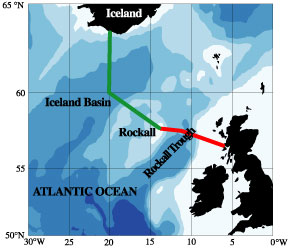 The Ellett Line is one of the longest-running and highest-quality ocean observation programmes in the North Atlantic. By repeatedly sampling the same route between Scotland and the Northeast North Atlantic, scientists have built a vital and unique record of change in a region that plays a crucial role in regulating Earth's climate.
The observations help researchers understand the circulation of warm and cold waters within the Atlantic Meridional Overturning Circulation (AMOC), a system that transports heat northwards and influences weather and climate across the UK, Europe and beyond. The data also improve climate models, support climate predictions, and provide insights into the health of marine ecosystems.
The value of the Ellett Line grows with every year of observations, providing a long-term record that allows scientists to distinguish short-term variability from long-term change.
Image: Map of the extended Ellett Line.
A Brief History
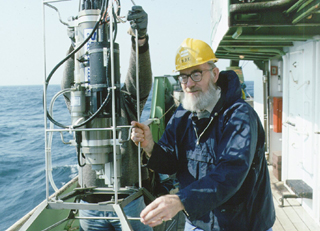 The origins of the programme can be traced to ocean observations made from weather ships in the North Atlantic from 1948 onwards. Building on this foundation, oceanographer David J. Ellett (pictured) established a dedicated hydrographic time series across the Rockall Trough in 1975, creating what has become known as the Ellett Line.
Over the following decades, regular research cruises transformed understanding of the waters west of the UK, revealing changes in ocean circulation, water masses and ecosystem conditions. In 1996 the programme expanded northwards towards Iceland, becoming the Extended Ellett Line.
It developed into the Ellett Array in 2019, under the Natural Environment Research Council (NERC)’s National Capability programme CLASS (Climate Linked Atlantic Sector Science).
The programme is jointly run by NOC and SAMS, and is funded through NERC.
Dive Deeper: Learn More About the Ellett Array
The Ellett Array and it's related projects have been running since 1996, with a number of significant publications and research expeditions carried out to learn more about the ocean to the west of the UK.