
My name is Ehoumi Paul Sossou, doctoral researcher at the Faculty of Sciences and Techniques, University of Abomey-Calavi in Benin, West Africa. I am a Benthic ecologist and biogeochemist of Estuary, Lake and Coastal Ocean Environments and study the impacts of climate change on aquatic organisms. It was thanks to the National Oceanography Centre's West P&I bursary that I joined the RRS James Cook cruise to the Porcupine Abyssal Plain Sustained Observatory.
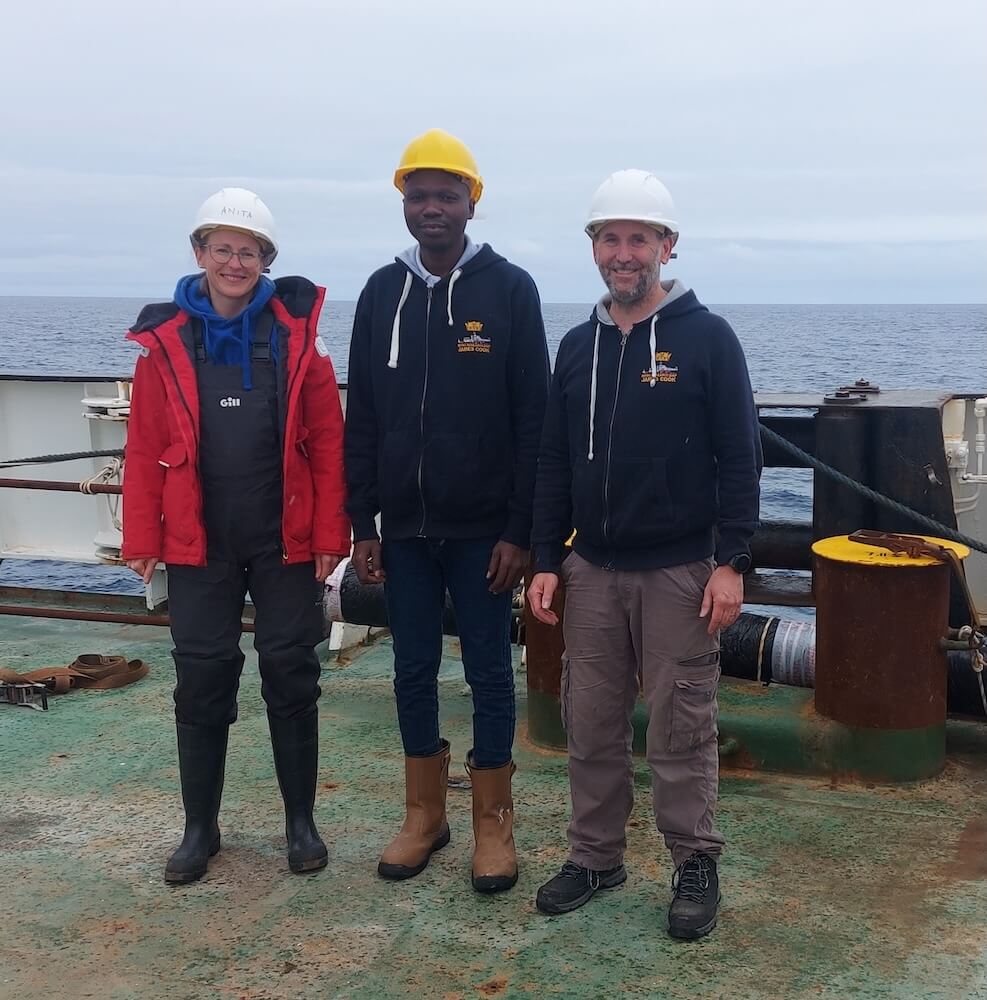
Ehoumi Paul Sossou (centre) aboard the RRS James Cook with Co-Chief Scientist Anita Flohr (left) and Principal Scientist Andrew Gates (right)
This is my first time at sea on a research ship, and it has been a significant adventure for me. I am undertaking the work within the benthic team. Given that I previously carried out sampling of sediments and macrobenthic organisms in shallow waters, the methodology applied in the marine environment is new and stimulating to me through the use of the megacore which allows sampling at a depth of approximately 5000 m. During the first two days of the cruise, life at sea was pleasant with low waves. But the following days were marked by strong waves leading me to discover another side of the sea and hindering the sending of the megacore to the bottom to collect sediments. The activities of the benthic team began in earnest towards the end of the first week of the expedition. The deployment of the megacore on the seabed is carried out by engineers and crew on board the ship and is recovered after approximately 4 hours.
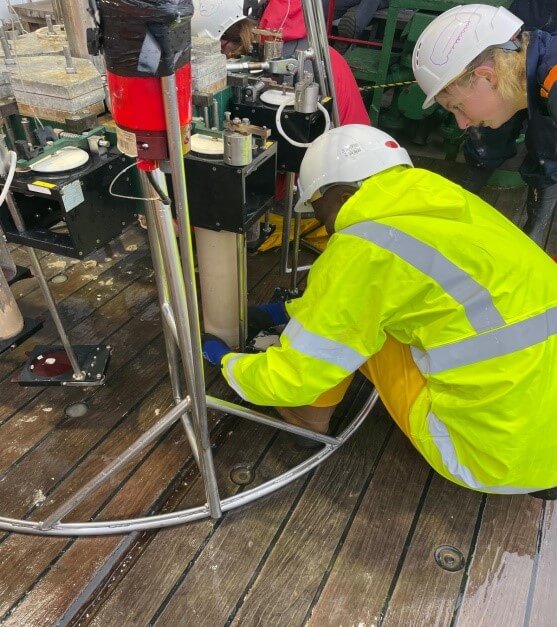
Recovery of high quality seabed sediment samples from the megacore.
As soon as the megacore is recovered with its eight core tubes well-filled with sediment, these cores are retrieved and processed using well-refined techniques. Our team (benthic team) is made up of several PhD students, benthic ecologists and biologists working on different themes. As a result, the sediments from the cores are sub-sampled at layers of varying thickness depending on the what the sample will be analysed for; for example 10 cm for metal analysis and 5 cm for quantifying benthic macrofauna.
When all the samples have been processed and preserved, it’s time to wash up our equipment and workspace, getting even muddier in the process. Once we have returned the core tubes to the frame, the megacore is sent down again for another deployment. The wait is then on for another few hours, before we do it all again.
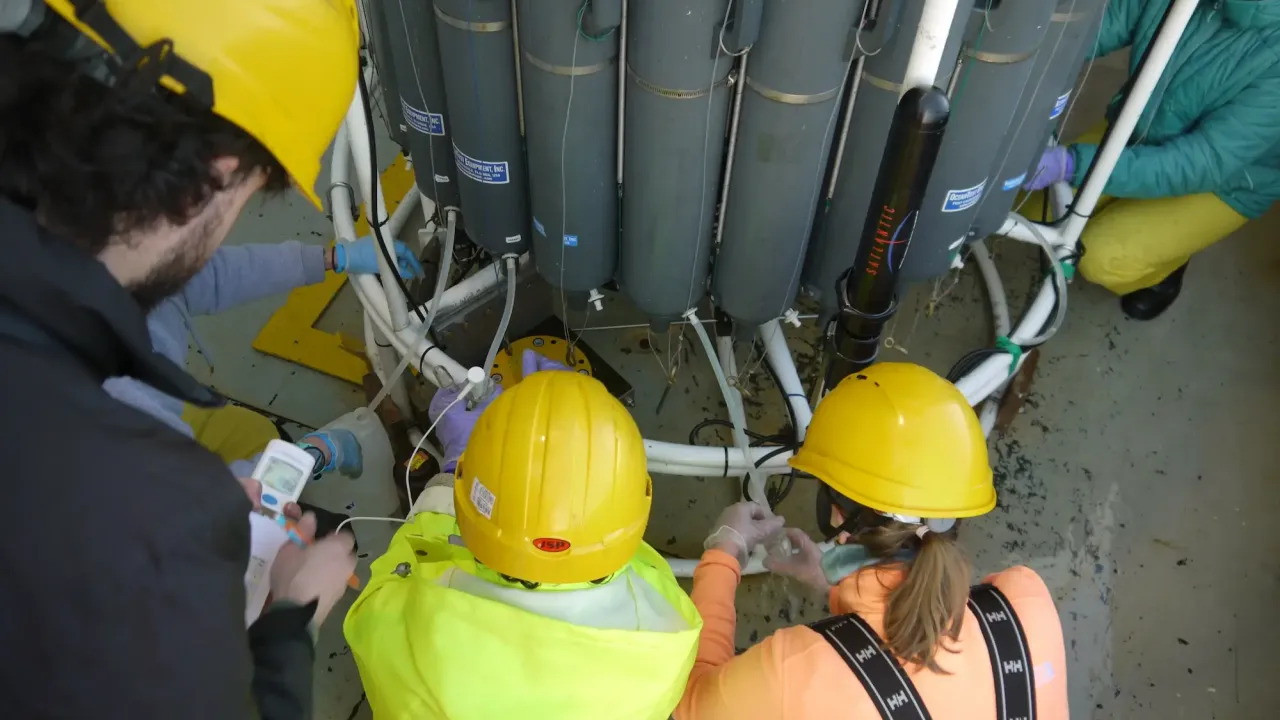
I also participated alongside the pelagic team in water sampling by the CTD for salinity, dissolved oxygen and nutrient analyses and chlorophyll-a concentration.
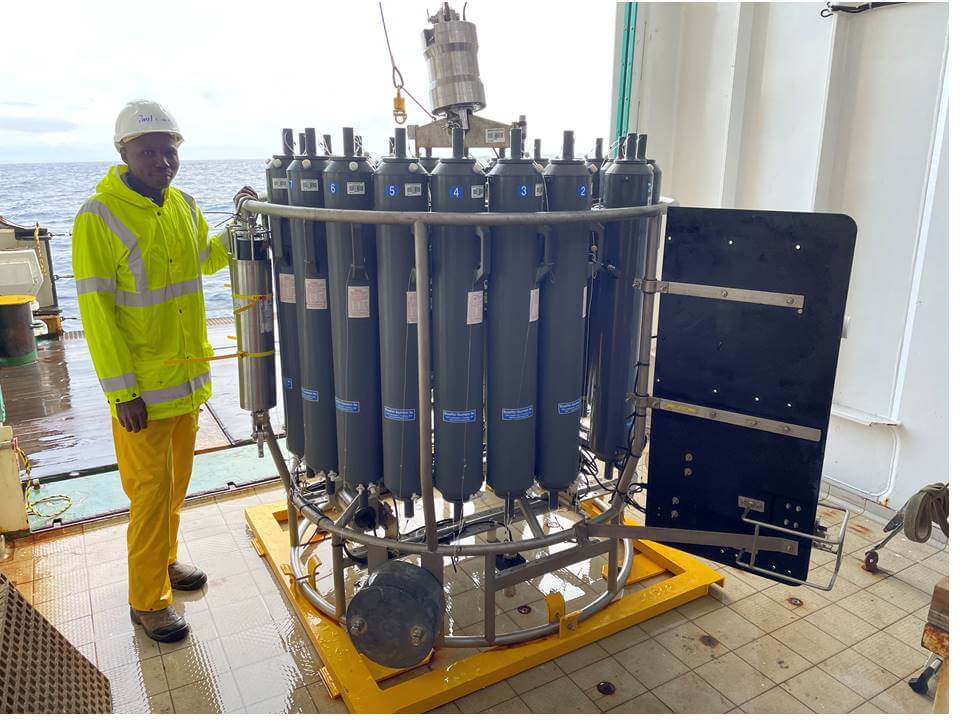
Collection of water samples for Chlorophyll a analysis.
This experience at sea is giving me a range of new scientific research skills. This research cruise gave me a chance of meeting many marine scientists too, and learning from their knowledge and experience. I also cannot forget the comfort and safety provided by the entire crew of RRS James Cook. They have made our lives easier and happier at sea. They have helped us collect the samples and the delicious meals prepared by the catering team were great stress busters.
Be part of the community helping our ocean thrive.