
Twenty days, 72 survey stations, thousands of water samples, towering icebergs, and one surprisingly resilient egg. Life at sea is never quite what you expect.
Told through the eyes of scientists on board RV Celtic Explorer, operated by the Marine Institute, this three-part blog series shares the challenges, discoveries and memorable moments from the 2026 AR7E expedition across the North Atlantic, offers a glimpse behind the scenes.
Part 1: ‘Don’t do a Titanic’: the adventures of AR7E on the RV Celtic Explorer by Dr Matt Clark, NOC Research Scientist and Co-Chief Scientist of the AR7E 2026 expedition.
Part 2: Deep-Sea Pressure vs One Very Brave Egg by Elena Garcia-Martin, Principal Investigator – Phytoplankton Dynamics at NOC.
Part 3: Deep Waters, Big Icebergs and New Perspectives by Soumaia Tajouri, Post-Doctoral Research Fellow in Physical Oceanography at University of Southampton.
To find out more about the GO-SHIP project, please visit the project website. Find out more about how the project was awarded 'The Oceanography Society’s prestigious Ocean Observing Team Award' here.
Be part of the community helping our ocean thrive.
‘Don’t do a Titanic’: the adventures of AR7E on the RV Celtic Explorer
An international team of 19 scientists at various stages of their career spent 20 days at sea onboard the RV Celtic Explorer, doing 12hr shifts, seven days a week during August. And we can’t forget the amazing 16-strong crew to help facilitate our work.
Our mission: to survey the GO-SHIP AR7E line between Ireland and Greenland. 72 CTD survey stations and over 7,000 water samples later, and we’re done.
It was also my first as ‘co-chief scientist’ under the amazing guidance of Dr Yvonne Firing, giving me hands-on experience of how a research expedition is planned and executed. And for the most part, things went to plan!
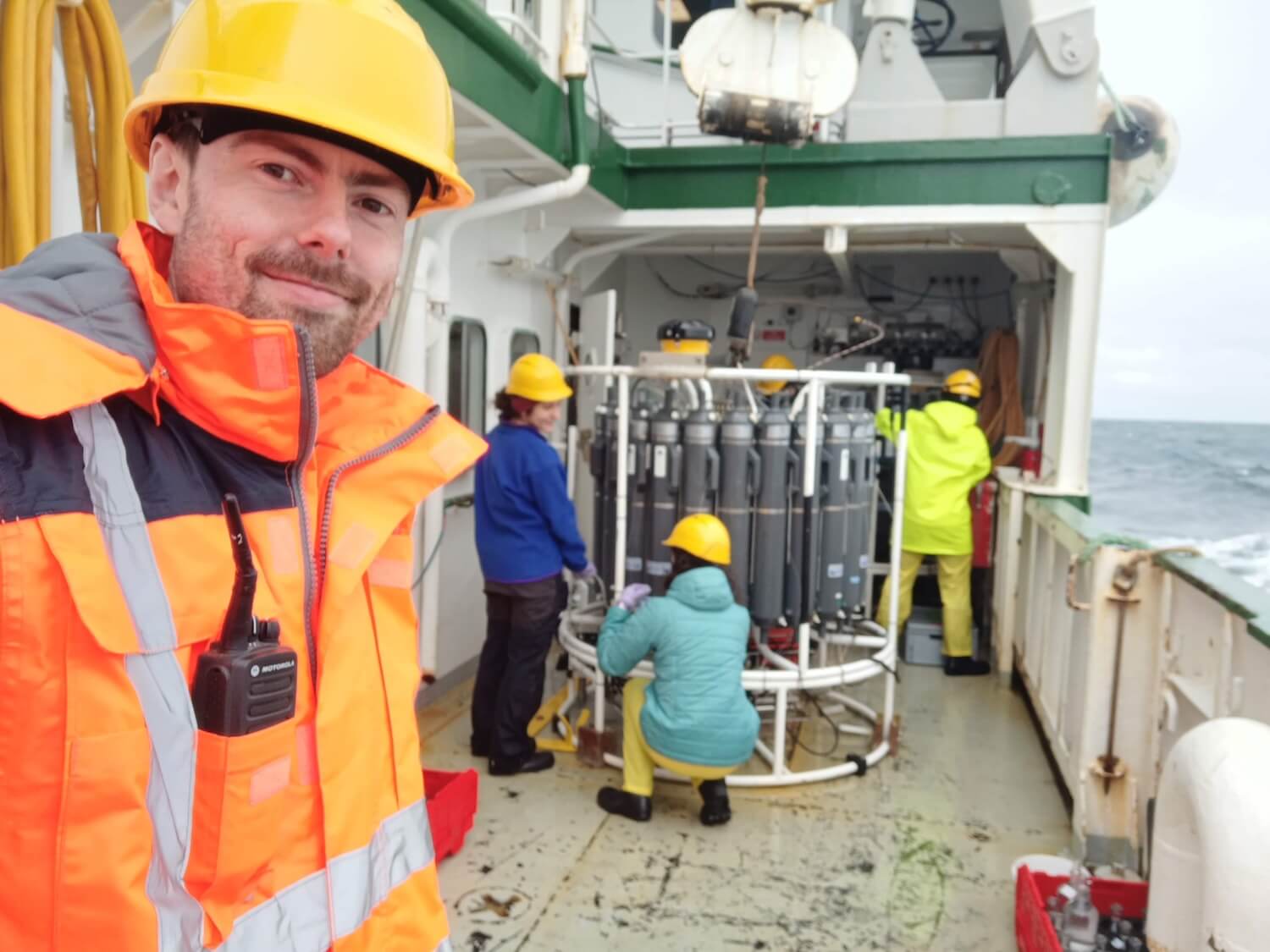
Co-chief scientist Dr Matt Clark overseeing CTD operations on the RV Celtic Explorer
Setting sail
The expedition started from Killybegs, Ireland and set off west towards Greenland along our survey line, leaving port to an escort of dolphins (a welcome treat) before heading out to two days of 3.5m waves. This was certainly a disruptive start to the survey, slowing us to a measly 5 knots against the strong headwind.
Many of the scientists, including myself, certainly felt the effects and were promptly seasick. Life at sea isn’t all glamour, after all! This also did mean we had to cut a small handful of stations to make sure we fitted within our schedule.
Our most important tool at sea
CTD stations were our main activity. CTD rosettes, or Conductivity-Temperature-Depth probe, is the main instrument of choice for an ocean scientist. In fact, it’s such a significant instrument, it’s celebrated worldwide by oceanographers on 22 January as CTD Appreciation Day!
They come with a range of sensors which allow us to measure temperature, salinity, pressure, oxygen, fluorescence, irradiance and turbidity in the water column.
It’s lowered from the ship’s winch down to 10m above the seabed (it has an altimeter on the bottom so we don’t hit the bottom, don’t want to damage the sensors). The frame also contained 24 10-litre sampling Niskin bottles which can be remotely closed by the operator (me!) from the comfort of the dry lab as we come back up to the surface. That’s so we can target any interesting features that the electronic sensors found.
Water samples were also taken via the ships underway surface water pumping system. The water samples that were collected were either analysed onboard or taken back to NOC or partner institutes for later analysis. We even got individual samples from the deepest point of the survey thanks to some excess bottles from one researcher.
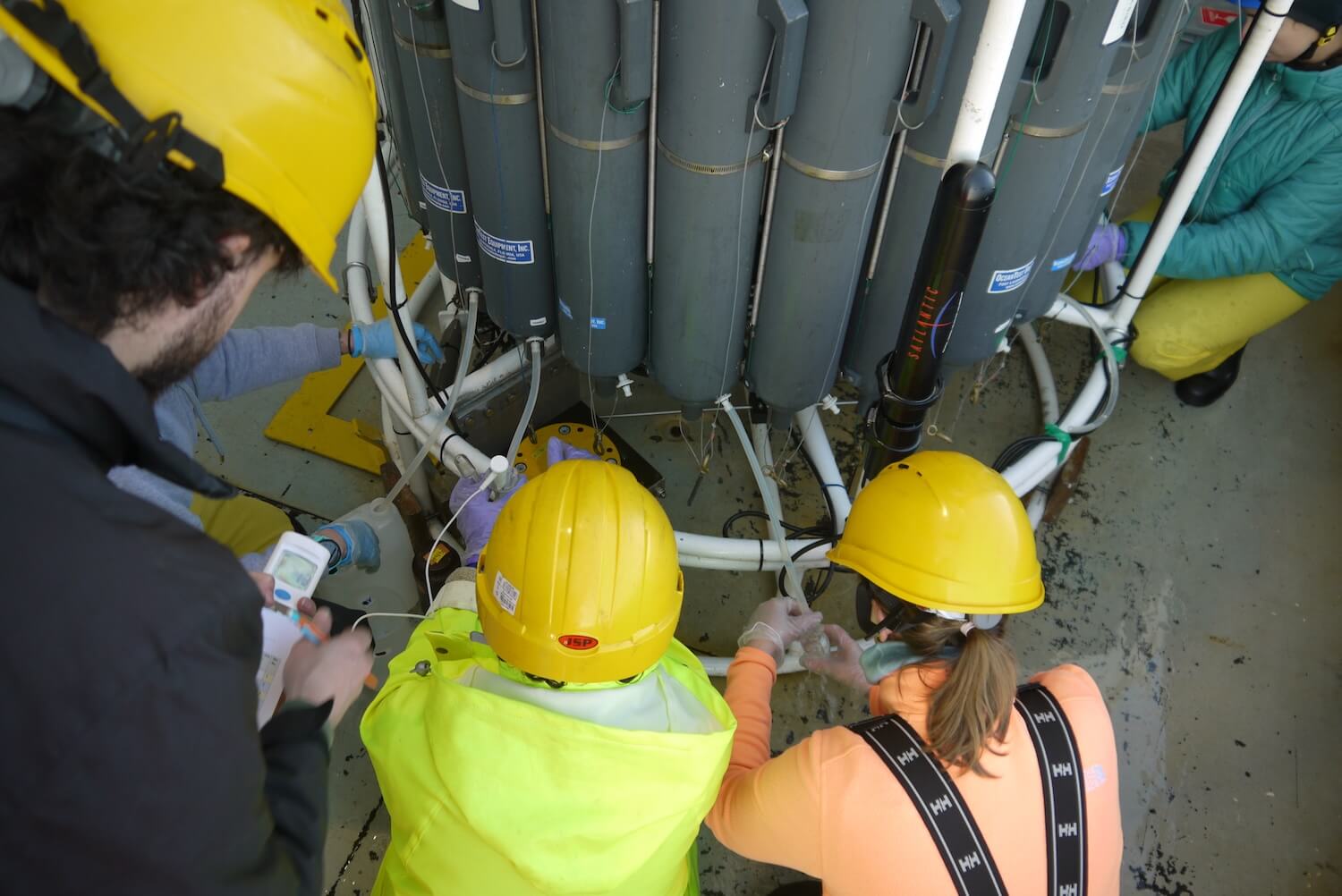
It's all hands on deck to collect samples when the CTD comes out of the water.
Icebergs ahead
‘Don’t do a Titanic!’ was something many said to me when chatting with friends and family back at home.
Why? Because this trip was characterised by icebergs!
We were acutely aware that our planned stations took us into iceberg territory on Greenland’s eastern coast. Now, I was expecting just the odd little lump, but nothing prepared me for the huge chunks of ice that we experienced, some much larger than the ship.
Of course, the bridge crew were keeping us safe, using the ship’s radar to look an astonishing 24-mile radius all around. This meant that we could see all the larger icebergs even through the thick fog that lingered for days and maintain a safe distance whilst passing and on survey station.
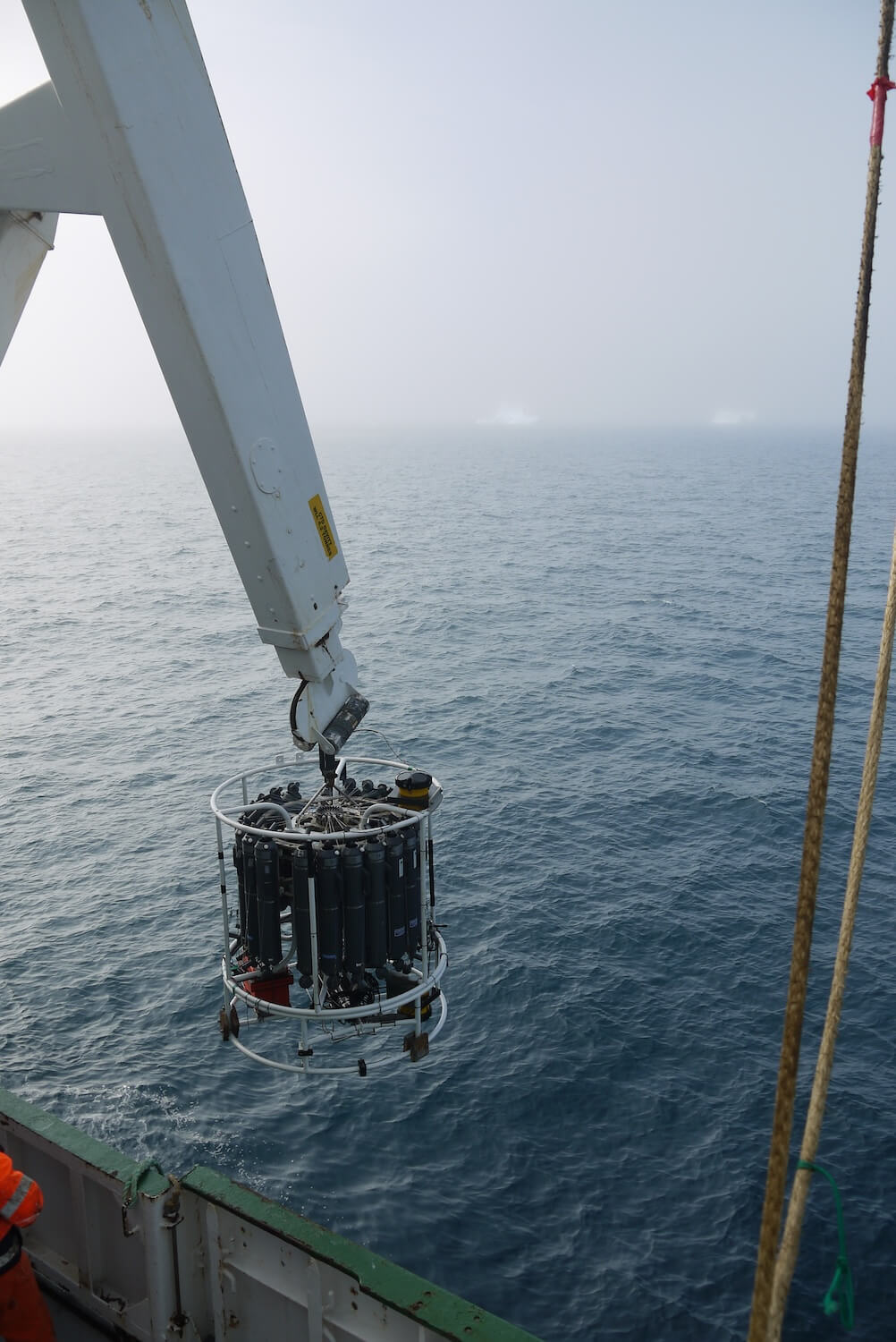
CTD deployment with icebergs in the background
So, the work is over now, right? Far from it!
While we are all back at our host institutes, there’s still samples left to analyse and data left to process. All the data (raw and processed) will eventually be uploaded to data centres for scientists around the world to study. And this analysis is what forms almost all my day-to-day job back in the office on land.
Deep-Sea Pressure vs One Very Brave Egg
One of the many traditions when we go to sea is to put Styrofoam cups inside socks and clip them to the CTD during the deepest cast.
Why?
Because it is a fun way to see the effect of pressure on everyday objects.
Objects that contain air shrink when they are exposed to very high pressure. They do not become as tiny as my beautiful plankton, but a Styrofoam cup usually shrinks to less than half its original size. On the AR7E cruise, we didn't want to break the tradition, so Pete got his tiny cup!
During dinner we were talking about it and saying that we should have packed more cups. But when preparing for a cruise, our packing lists are usually full of pipette tips, blue roll paper, gloves, tubing, cable ties, and scientific equipment. Styrofoam cups rarely make it onto the list, at least not on mine!
Dinner on board is also a special time. After an intense day of work, it is our chance to relax, have a break, and let the little ‘kids’ inside us ask all those what if? questions.
One crew member suggested sending a banana to the deep sea. We quickly said no; that would contaminate my dissolved organic carbon samples! But then someone asked: ‘what about an egg?’
The debate started immediately.
Would the egg break or not? It has a very strong curved shape, so perhaps the pressure would be distributed evenly. It is also mostly filled with liquid, so maybe it would be fine. Everyone joined the discussion, and the yes and no votes were surprisingly balanced.
As scientists, we did what scientists do: we tested it.
The first challenge was finding an egg. Fortunately, the kitchen came to the rescue. After a quick chat with the head chef, we had our egg. We painted it to make it look a little prettier, placed it inside Pete's special CTD sock, and sent it down to 3,150m!
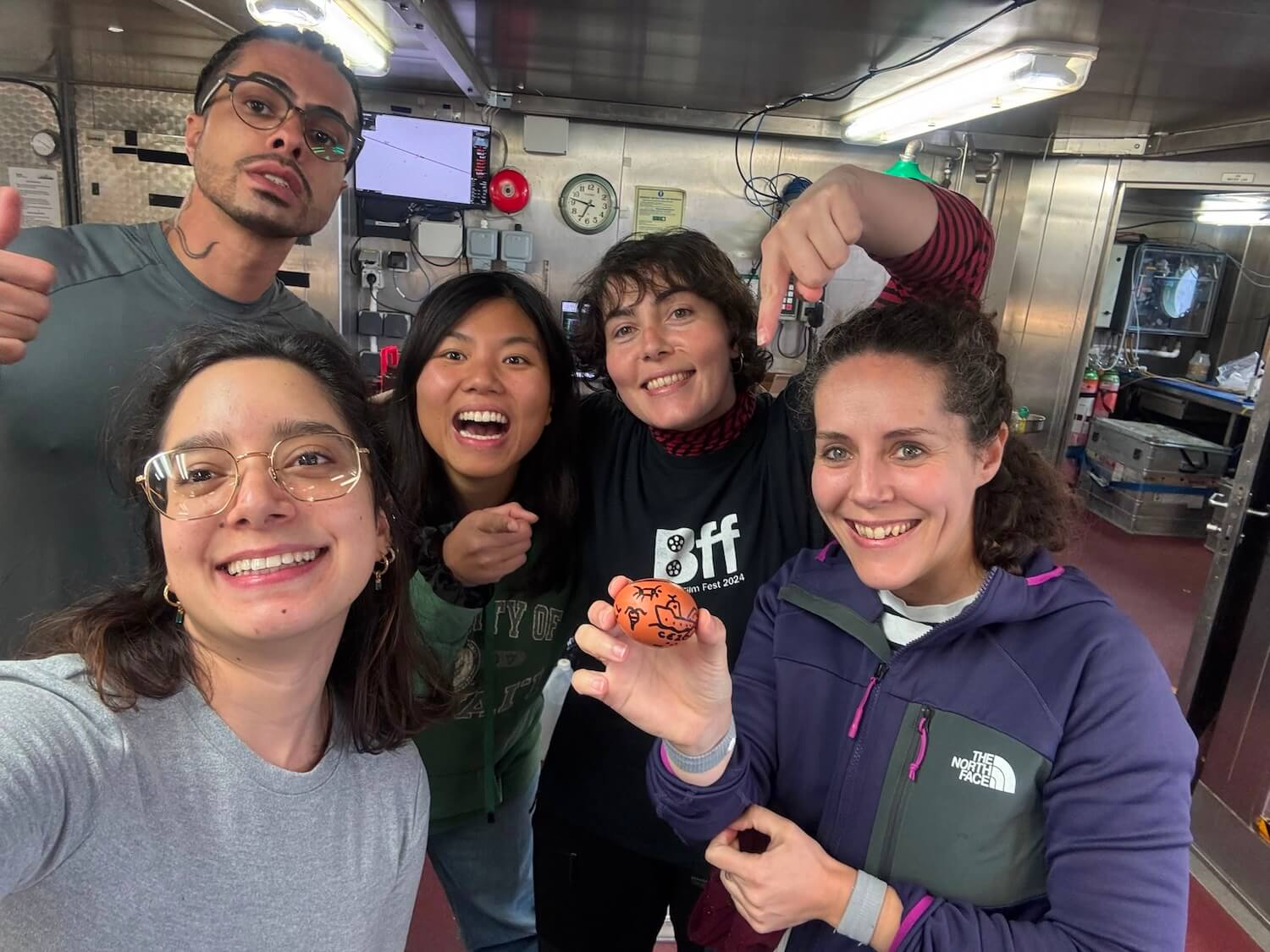
An egg-cellent adventure awaits
It takes about two hours for the CTD to travel to 3,000m and back to the deck. Once it was safely secured, we checked the sock...
And…
…The egg was in perfect condition!
A quick Google search later told us that we were not the first people to have this idea. Researchers on a previous Arctic deep-sea expedition had carried out a very similar experiment.
So, why didn't the egg shrink while the Styrofoam cup did?
The answer is physics. Water pressure pushes equally in all directions. The curved shape of an eggshell helps distribute that pressure evenly across the shell, so no single point experiences more force than another.
In addition, an egg is almost entirely filled with liquid, which is very difficult to compress. However, a Styrofoam cup contains many tiny pockets of air, and those air pockets collapse under the high pressure, causing the cup to shrink.
The same principles help many animals that migrate to the deep ocean. As their bodies contain very little air, they can withstand the enormous pressures of the deep ocean without being crushed.
This little experiment not only sparked scientific discussions, but also gave us a chance to laugh, be curious, and get excited. When you work 12-hour shifts every day, those moments become especially valuable as the tiredness starts to accumulate.
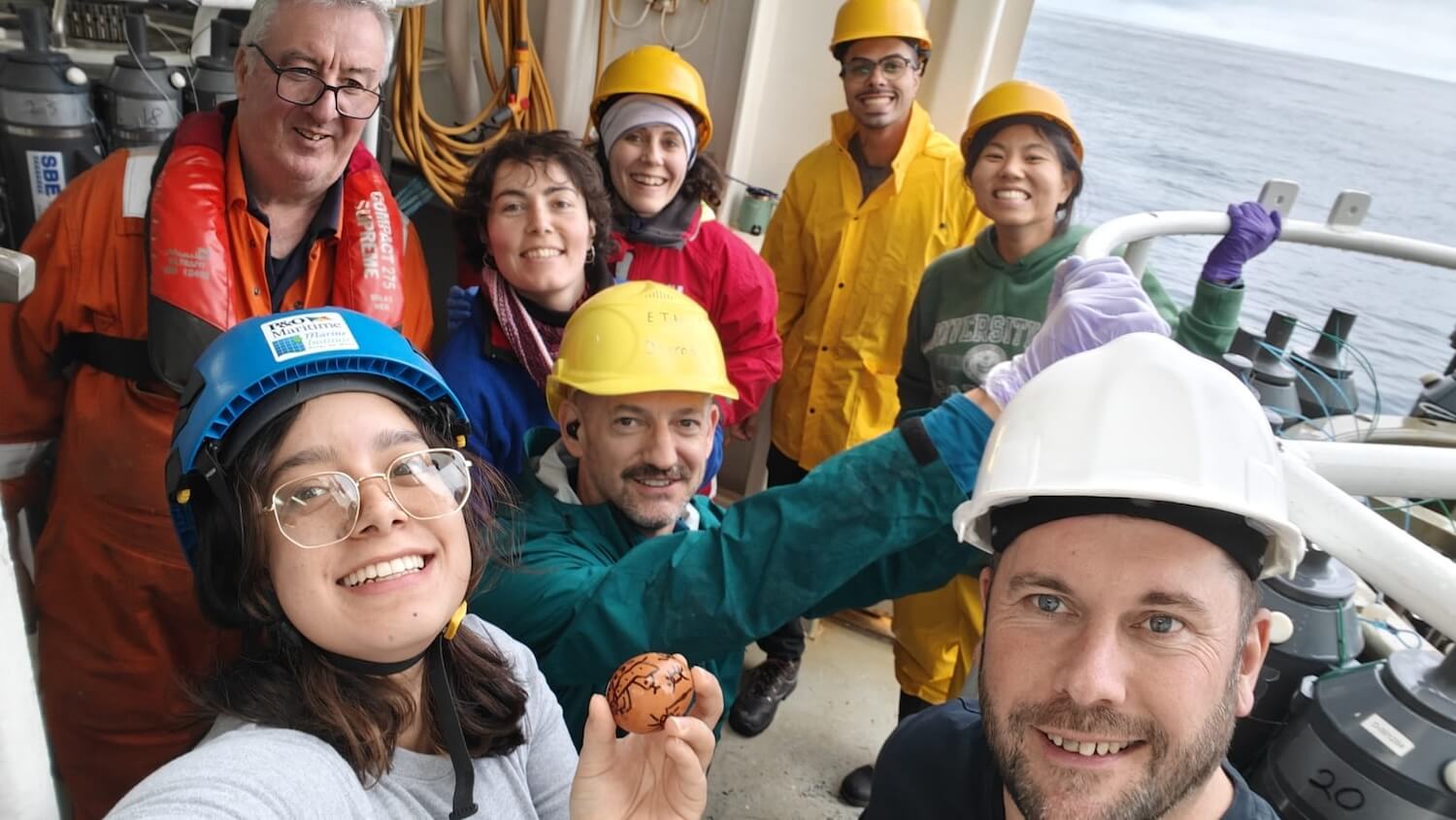
The egg that refused to crack under pressure
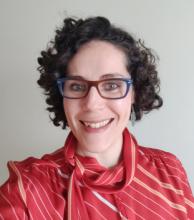
Deep Waters, Big Icebergs and New Perspectives
My research focuses on ocean circulation in the subpolar North Atlantic and the Arctic Ocean. I am particularly interested in the impact that freshwater fluxes from rivers and the Greenland Ice Sheet can have on the global overturning circulation and the wider implications for climate and regional sea level rise.
At Southampton, my work involves developing model diagnostics and analysing ocean and climate simulations to characterize changes in the anatomy of the Atlantic Meridional Overturning Circulation as it weakens.
I was very keen to join the AR7E GO-SHIP cruise to learn more about the region I am studying with models and take part in hydrographic observations. On board the ship, I was sampling dissolved oxygen, salinity, and radionuclides from the CTD rosette and salinity from underway water. I also analysed salinity and helped with the post-processing of VMADCP and underway data.
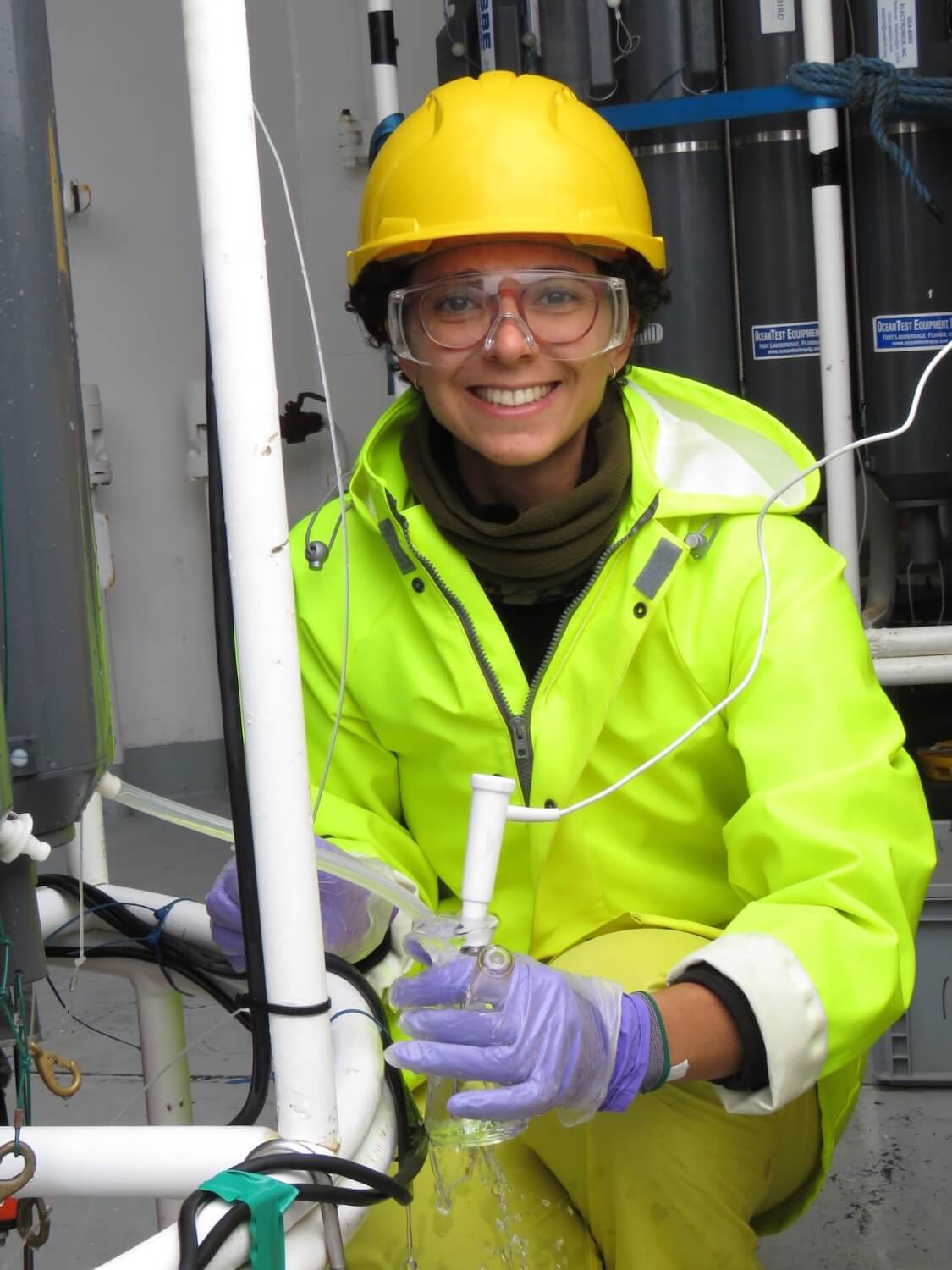
Soumaia collects samples of dissolved oxygen
Besides these daily tasks, I met with the various researchers on board and learned about the collection and analysis of the other ocean properties (such as pH, alkalinity, tracers).
I could also share my work and learn about other people’s work during the seminars that were organised on board.
I was very excited by the sight of the Greenland coast and icebergs, as well as by the sampling of the deepest waters we would collect during the cruise (the famous North Atlantic Deep Water!).
All in all, this research cruise has been one of the best experiences in my life, which was only possible thanks to the amazing people who made this time on the ship as enjoyable as possible and to whom I am truly grateful.
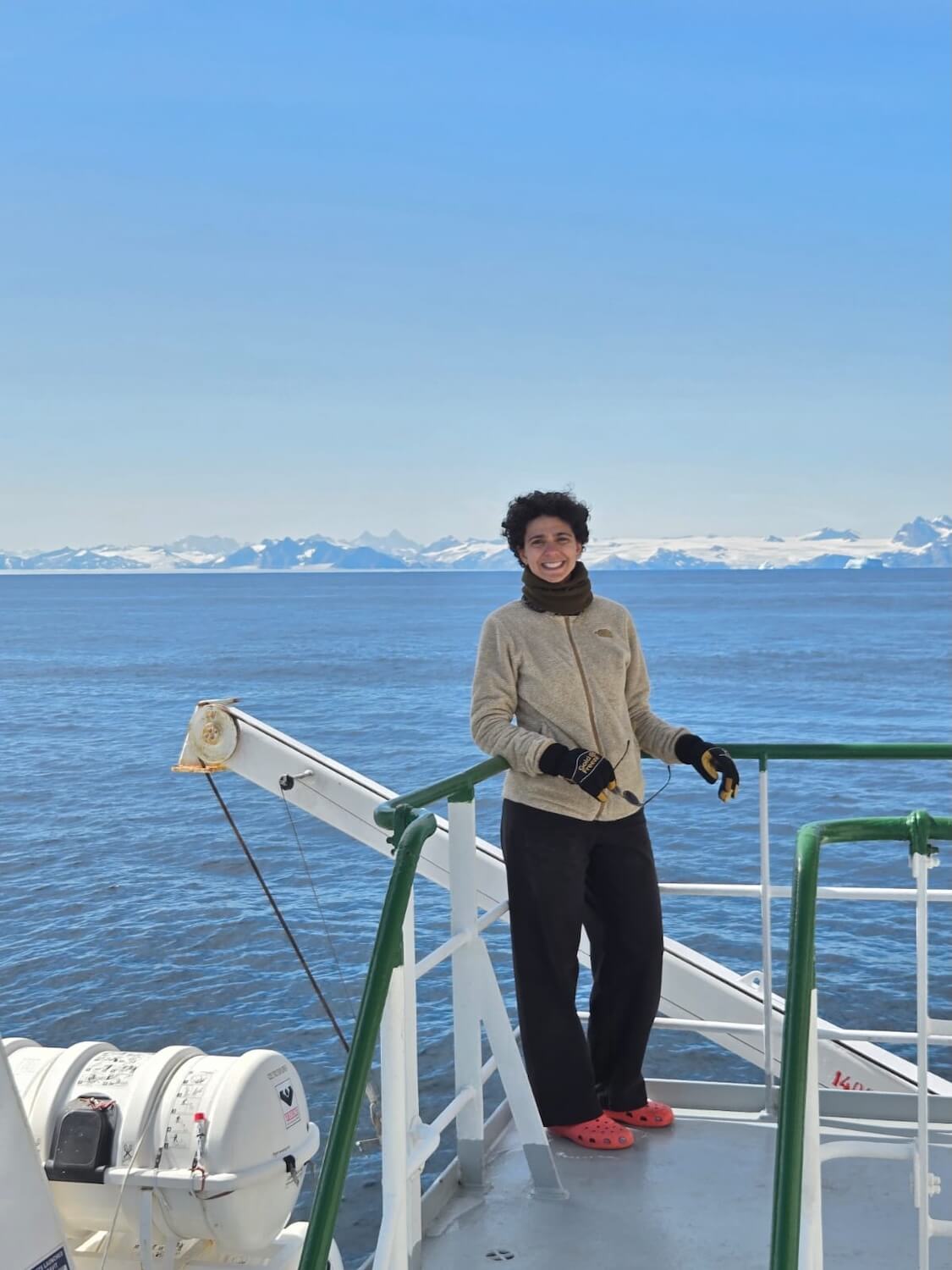
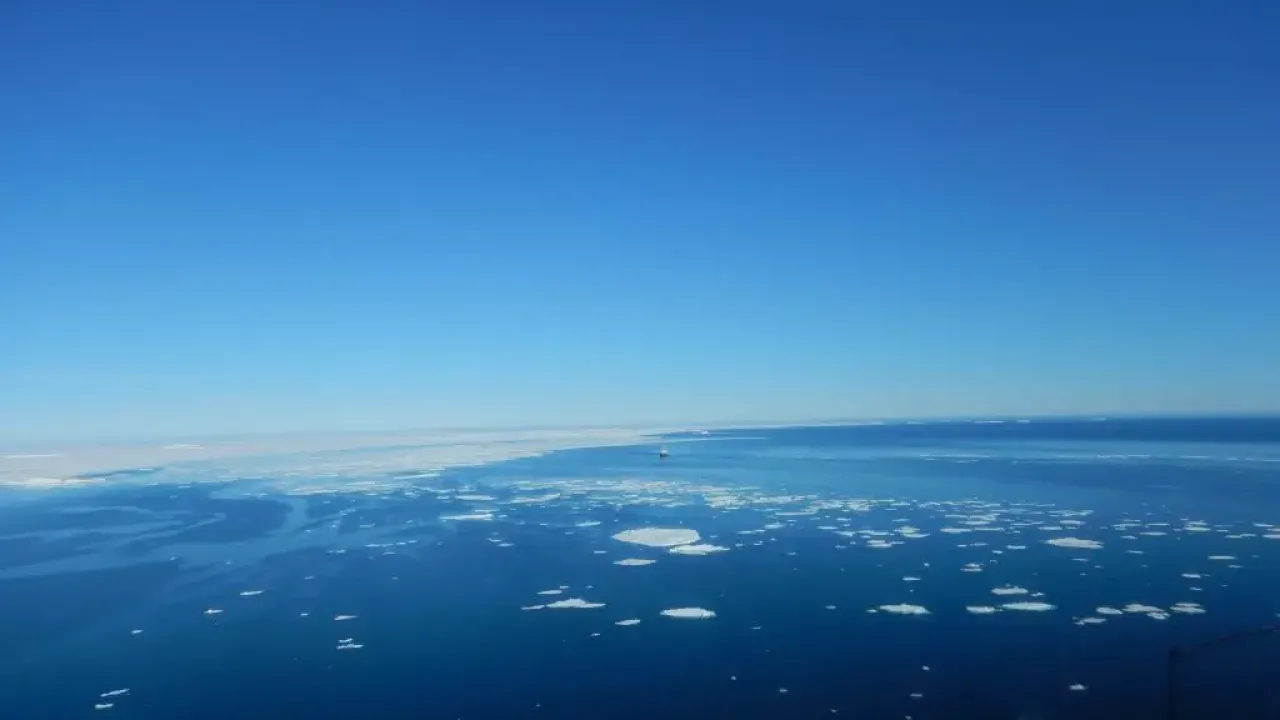
All clear! Sunshine and icebergs close to the east Greenland coast