
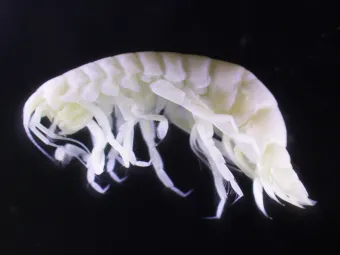
A newly described species of deep-sea amphipod has been named in recognition of National Oceanography Centre (NOC) taxonomist Dr Tammy Horton, honouring her outstanding contributions to marine taxonomy and deep-sea biodiversity research.
The species, Vemana hortonae Hendrycks & Thurston, 2025, was described in a recent publication in the journal Zootaxa. It was discovered at abyssal depths exceeding 5,000 metres in the eastern tropical Atlantic Ocean. The new species is part of the little-known genus Vemana, which now comprises seven valid species, several of which are known from only a handful of specimens.
Dr Ed Hendrycks (Canadian Museum of Nature) and Dr Michael H. Thurston (NOC) led the taxonomic work, drawing on material collected during two historic deep-sea expeditions: RRS Discovery Cruise 63 in 1974, and held in the NOC Discovery Collections, and the DIVA-2 expedition aboard RV Meteor (M63/2) in 2005. These samples were obtained using highly specialised equipment, including acoustically monitored epibenthic sledges and box corers.
A Legacy in Amphipod Taxonomy
Vemana hortonae was named in honour of Dr Horton’s extensive expertise in amphipod taxonomy, particularly her work on scavenging species that play a key ecological role in the deep ocean by consuming carrion and other organic material.
Dr Horton has made a lasting impact on the global taxonomic community collaborating internationally to advance taxonomic research and data accessibility. She served for six years as Chair of the Steering Committee for the World Register of Marine Species (WoRMS) and leads the World Amphipoda Database where she has entered and edited more than 22,700 amphipod records to the database, more than any other individual contributor.
Dr Horton said, “I am really honoured to have this new species named for me. It is particularly special to have been given this honour by two amphipod taxonomists I have learned so much from during my career.”
Rare Discoveries from the Deep
Alongside Vemana hortonae, the study also describes a second new species, Vemana cuspidata, collected from the same deep-sea regions. The discoveries have increased the total number of known Vemana specimens by 67%, a significant leap for a genus characterised by its rarity and limited historical material.
Detailed morphological comparisons were made using compound microscopy and digital illustration, in line with modern taxonomic standards. Type specimens of V. hortonae are housed at the Natural History Museum, London, while V. cuspidata is deposited at the Canadian Museum of Nature, Ottawa.
These findings underscore the continued importance of preserving and re-examining historic deep-sea collections, as well as the vital contributions of researchers like Dr Horton to understanding Earth's least-explored habitats.
Be part of the community helping our ocean thrive.