

More time is needed to fully understand the state of the Atlantic Meridional Overturning Circulation (AMOC).
That’s the view of scientists in the RAPID research team, who have released the latest AMOC time series today (Friday 26 September 2025).
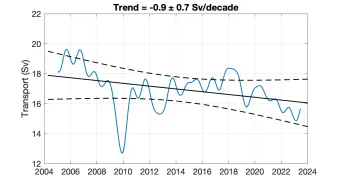
The overall picture suggests the weakening trend in the AMOC has remained consistent.
Dr Ben Moat, who leads the open ocean physics team at the National Oceanography Centre (NOC), said: “The AMOC weakening has remained stable since the last update, at -0.9±0.7 Sv/Decade over the 20 years of observations.
“However, it is crucial to continue observing the AMOC through to at least 2034 to ascertain its trend and confirm if it is natural long-term variability or anthropogenic in nature.”
Since 2004, RAPID has built an unprecedented time series of AMOC observations at 26N in the Atlantic Ocean, with 143 scientists and 229 technicians involved in collecting data over the past two decades.
This sustained long-term observing is crucial for detecting changes in the AMOC that could affect UK and European weather and climate.
What is AMOC?
The AMOC is a vital component of the Earth’s climate system. It transports warm surface water northwards and returns cooler water southwards at depth, helping to regulate weather patterns across Europe, Africa and the Americas.
As well as regulating global climate, it is also vulnerable to the effects of changes in climate. In the past 100,000 years, rapid variations in the Earth’s climate have been attributed to an AMOC shutdown.
Future projections from climate models demonstrate a weakening in the AMOC, which could have serious implications for society. However, these projections require comparisons to AMOC observations for evaluation of their accuracy.
What does RAPID do?
RAPID science has revolutionised the way we understand ocean circulation, and continues to provide vital answers to fundamental questions including the storage of carbon in the ocean as well as the influence of the AMOC on European weather.
RAPID observations also form an essential part of high impact climate assessments, which provide evidence for key policy advice and guidance.
The AMOC time series are freely available to download from www.rapid.ac.uk
Be part of the community helping our ocean thrive.