
New research has found that tens of thousands of metal mines and mine waste sites pose a pollution risk to almost 300,000km of the world's coastline, a threat set to grow as climate change accelerates.
Metal mines and their storage facilities could pollute up to 292,805 km of the world's coastline, enough to circle the Earth more than seven times, potentially posing a threat to marine life, fisheries and coastal livelihoods.
Scientists from the National Oceanography Centre (NOC), working with Plymouth Marine Laboratory (PML), have published a paper in Earth-Science Reviews, which for the first time, assesses the scale of the threat that metal mining could pose to the marine environment, and shows how it could worsen due to future climate change.
The study analyses a global database of near-shore metal mining sites, identifying the coastal hot spots most likely to be impacted by potentially hazardous metal mining waste release and identifies an urgent need for prevention and monitoring strategies in these regions, guided by scientists, governments, and industry stakeholders.
Metal mining has quadrupled over the past 55 years to meet growing demand. The waste this leaves behind could pollute rivers and coastlines with potentially hazardous metals for centuries. Until now, no study has mapped how much of the global coastline is exposed to mining waste, leaving these valuable areas unprotected and unmanaged towards this threat.
The research team identified 4,094 active mines, 28,563 inactive mines and 11,472 tailings storage facilities located close enough to the coast to pose a contamination risk, along with 12 recorded tailings dam failures that have already reached the sea.
What this study reveals is the enormous scale of the potential risk to our coastlines. We knew mining pollution was a serious problem for rivers and floodplains, but the potential threat to the marine environment has received far less attention. When we mapped it out, tens of thousands of sites turned out to sit close enough to the coast to potentially pollute nearly 300,000 kilometres of shoreline. This is a global problem that threatens vulnerable communities and ecosystems, and it is likely to get worse as we see increasing weather and climate extremes in response to anthropogenic climate change.
Dr Adam Sproson, research scientist at NOC and lead author of the study
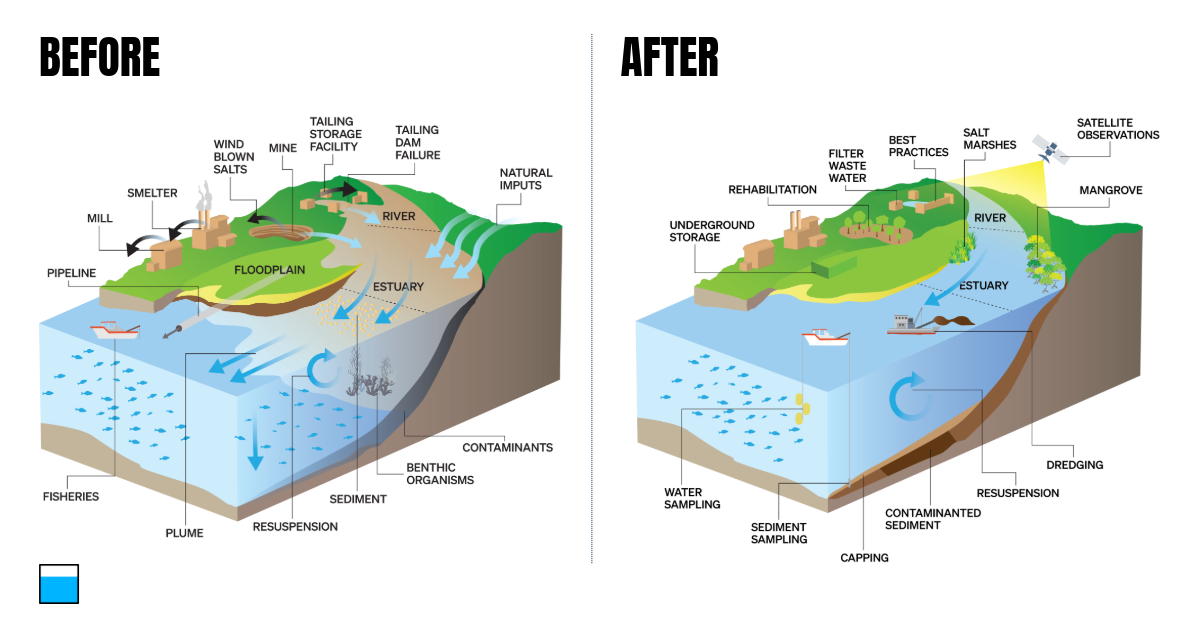
Mining can deliver contaminated sediments to rivers, estuaries, and the sea affecting the animals and plants living there (left), but various technologies can find and greatly reduce toxic inputs to protect ecosystems (right).
Metals released by mining can accumulate in coastal sediments and marine life, damaging ecosystems and fisheries and posing a potential risk to human health through contaminated seafood. The team compared the location of mine sites to worst-case projections of rainfall, sea-level rise and other climate hazards for the year 2100 and found six regions where these hazards overlap most with mining pollution: North and South America, northern Europe, the Mediterranean, East Asia and Australia.
Perhaps counterintuitively, the researchers found that slow, long-term leakage from active and long-abandoned mines is likely to pose the bigger overall threat to coastlines not the rarer, more dramatic tailings dam failures that tend to make headlines, such as Brazil's Fundão disaster in 2015.
The tailings dam failures are catastrophic and tend to grab headlines, but our new analysis shows that longer-term leaching from active and inactive mines, some of which have been abandoned for a century or more, potentially presents a bigger risk to the marine environment. This new knowledge can have real implications for how we monitor and regulate marine contamination. We need a combined approach to monitoring and managing mining pollution, following the different contaminants from the mine site through rivers and coastal waters into the ocean.
Dr Anna Lichtschlag at NOC and co-author of the study
The authors say the findings make the case for better ocean- and satellite-based monitoring of at-risk coastlines, greater investment in cleaning up legacy mine sites, and stronger, legally binding regulation, particularly in the six hotspot regions the study identifies.
Most of what we know about mining pollution comes from rivers and floodplains, which has left the coast as something of a blind spot. Some water pollutants cannot be detected directly by satellite imagery. However, we can use satellite-detectable indicators, such as suspended particles in the water, to help identify and monitor these pollutants in different regions. Satellites offer a low-cost way to see where rivers carry that material out to sea, facilitating governments and industry in the decision-making process of where to monitor.
Dr Elizabeth Atwood, Earth Observation Senior Scientist at Plymouth Marine Laboratory (PML), and co-author of the study.
The research was funded by the Natural Environment Research Council (NERC, grant NE/X006271/1).
Read the paper here: https://doi.org/10.1016/j.earscirev.2026.105683
Be part of the community helping our ocean thrive.